
At a glance
- Page topic
- Bait stations — how they work
- Area covered
- Riga and the surrounding region
- Price
- From €40 — the figure quoted is the final price
- Availability
- 24/7, weekends and nights included
- What works
- Metal mesh with a 5 mm aperture and cement mortar; expanding foam does not
- How to book
- Enquiry form only — we reply within 5 minutes
The difference between poison put down in the open and a bait station is the same as the difference between an open tub of chemicals and a locked container.
How it is built
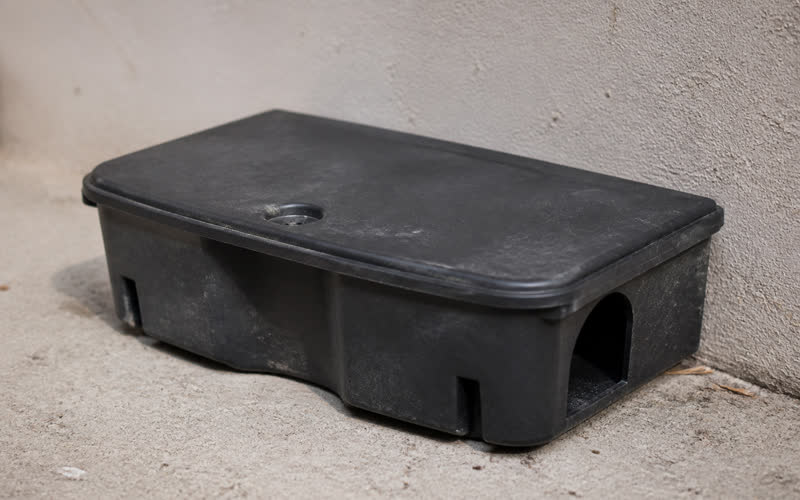
A rigid plastic container with two small rodent-sized entry holes, an internal compartment for the bait and a lockable lid. The bait is fixed on a rod, so the rodent cannot carry it out.
Why it is safe
The lid only opens with a key. The entry holes are too small for a child's hand, a cat or a dog. The station is fixed to the floor or the wall, so it cannot be tipped over or moved.
Where they are placed
Along walls, on runways, at pipe entries, in basements and around the perimeter. Never in the middle of a room — rodents do not travel there.
Control points on commercial sites
On commercial sites every station has a number and a position on the plan. At each check we record which point the bait has been taken from — that shows which side the pressure is coming from and lets us adjust the layout.
Why a station tight against the wall works and one 30 cm away does not
Rodents move along the wall, not across the middle of a room. This behaviour is called thigmotaxis: the animal keeps constant contact with a vertical surface through its flank and whiskers, because that is how it navigates in the dark and how it feels protected from birds and cats. In practice this means something very concrete. A bait station set half a metre out from the wall can stand untouched for a month, while the identical station pushed tight against the wall starts working in the first few nights. The gap between the station and the wall should be zero — any hole between them creates a narrow run that a rat will use to go past rather than in. The station's entrance should be oriented parallel to the wall so the rodent enters in its direction of travel instead of having to turn 90 degrees. A corner where two walls meet is the best point of all: two runways cross there.
Spacing between stations indoors and on the external perimeter
Spacing is dictated not by floor area but by how far the species travels. A house mouse moves within a few metres of its nest and rarely goes further than 3 to 10 metres, so in rooms with a mouse problem control points go every 2 to 3 metres along the wall line. The brown rat ranges much wider, and its nightly route comfortably covers 30 to 50 metres, so on a rat site the spacing indoors is 8 to 12 metres. On the external perimeter along the foundations the logic changes. There you are not covering an area but a line of approach — stations go at 10 to 20 metre intervals, more densely at the bin area, the service entrance, basement hatches and the points where services enter the wall. Even spacing all the way round a building is a mechanical approach that ignores the fact that a rat does not come from just any direction.
How a station is fixed down and why an unfixed station is dangerous
Fixing down is the part most often skipped in do-it-yourself solutions. Indoors the station is fixed to the floor or the base of the wall with a plug or adhesive, depending on the surface. Outdoors on asphalt or paving it is anchored directly; on soil, metal pegs go through the holes in the base, or less often a concrete slab inside the station acts as ballast. Fixing serves two purposes. First, safety: a child cannot pick up, tip over or carry off a station that is screwed down, and a dog cannot drag it somewhere it can be opened. Second, data: if the station travels around the site, the control point number no longer means anything and comparing consumption between visits becomes useless. A free-standing box of poison in the middle of a floor is not a control point. It is simply poison in a box that can end up anywhere.
What servicing a station actually involves
Servicing is not topping up the bait. At each visit the station is opened with the key and every step is worked through. First we assess consumption — how much product is missing compared with last time and whether there are gnaw marks typical of a rat or a mouse. Next we check whether what remains has spoiled: gone mouldy, damp, dusty or faded. Spoiled product is removed and replaced even if nothing has touched it. The inside of the station is wiped clear of dust, droppings and building debris, because a dirty interior in itself puts a rodent off going in. The point number, date, level of activity and actions taken are recorded. If a point is completely quiet for several visits in a row while there is activity in the neighbouring zone, the station is moved — that is a normal working step, not an admission of error.
Monitoring blocks with no active ingredient: when they are the right choice
Not every station needs a rodenticide in it. Monitoring blocks are externally identical, with the same smell and hardness, but with no active ingredient — their only job is to show whether rodents are working a point. They are the right choice in several situations. After a successful treatment, when the population has been cleared and the site needs an early warning system without a permanent presence of poison. In food production and storage areas, where poison is kept out of indoor points altogether and the active ingredient stays on the external perimeter only. On sites where it is not yet clear whether there is a live problem and you need two weeks of fact rather than guesswork. A gnawed block is a clear signal, after which the contents of that particular point can be changed. This approach also reduces the total amount of poison on site, because the active ingredient only goes where it is genuinely needed.
Reading consumption as data about the entry point
A bait station is a measuring instrument, not just a container. When a site has 12 points and consumption concentrates in two of them over several visits, that is a direct pointer to the route in. A rodent does not walk past ten stations to feed at the eleventh — a heavily eaten point means the nest or the entry point is close by, usually within a few metres. The next step is to look for the actual hole near that point: an unsealed pipe through a wall, a ventilation grille with no mesh, a loose basement window hatch, a gap under an external door. Even, scattered consumption across all points says something different — a large population with no single dominant entry, and that changes the treatment plan. Consumption stopping suddenly at every point at once usually means a more attractive food source has appeared on site: an open bin, a spilled load, a new place where food is stored.
What spoils bait and how often it needs changing
Product in a station is spoiled by conditions, not by the calendar. Damp is the main enemy: in Riga basements with high humidity, grain-based bait can start to go mouldy within a few weeks, so wax block formats are used in those places, as they stand up to damp considerably better. Dust and cement fines on building sites coat the surface and take away the smell, which is the only thing that draws a rodent in. Direct sun through the lid of an external station heats the inside and dries the product into a hard, scentless lump. Another reason for replacement is time without contact: even in ideal conditions, product left untouched for a couple of months is no longer as attractive as fresh. In practice, then, the planned servicing interval is roughly a month — less often in dry, clean rooms, more often in a damp basement or a dusty production plant. Replaced material is taken away and disposed of, not left on site.
Frequently asked questions
Is a station safe around children?
Yes, it is lockable and has small entry holes.
Can the station be moved?
There is no need — the layout is chosen to follow the runways.
How long does the bait last?
It is checked and replaced at the regular visits.
Why should the client not open or check the station themselves?
The key is part of the safety solution, not a formality. An opened station loses the barrier between the product and a child or a pet, and if it is closed carelessly it no longer seals properly. On top of that, touching the contents introduces a foreign smell that can keep a wary rat away from the point for several days. If you suspect activity or damage, fill in the form and we will check the point.
What makes a real bait station different from a plastic box sold in a shop?
The difference is in the construction, not the look. A professional station has a lockable lid with a key, an internal baffle that stops the product being reached from the entrance, a fixing to the base and a retaining rod the bait is threaded onto and cannot be carried off. A cheap box with two holes is usually just a cover — the contents sit loose inside, can be pulled out and carried away, so it offers no safety advantage at all.
Can stations be used outdoors in winter?
They can, and in winter the external perimeter is often the most important part. In the cold, rodents move towards buildings, so points at the foundations, service entries and basement hatches work harder than they do in summer. There are two practical points: the station has to be fixed so that snow clearing does not disturb it, and a damp-resistant product format has to be chosen, because alternating thaws and freezes break down less durable baits.
How many stations does my site need?
That is decided not by square metres but by the species, the runways and the risk areas. A single flat with mice may need only a few points along the kitchen and bathroom walls; a warehouse with rats calls for both an internal line along the walls and a full external perimeter. The exact number is set at the inspection, once we can see how the droppings are distributed, where the entry points are and how the site is laid out. Fill in the form and we will reply within 5 minutes.