
At a glance
- Topic
- Signs that rodents are present
- Signs
- Droppings, grease marks, gnawing, noise
- Mouse gap
- From 6–7 mm
- Rat gap
- From 20 mm
- What fixes it
- Inspection, bait stations or traps, sealing entry points
- How to book
- Enquiry form only — we reply within 5 minutes
Rodents are rarely seen. In most cases the problem is discovered from indirect signs, and the sooner they are noticed, the simpler the treatment.
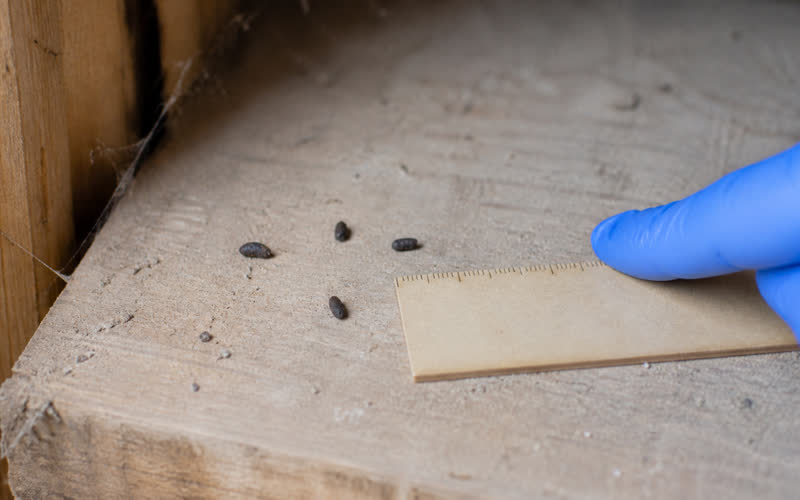
1. Droppings
The most reliable sign. Mouse — 3–6 mm, rat — 15–20 mm. Fresh ones are dark and soft, old ones grey and crumbly.
2. Noise at night
Rustling, scratching or footfalls in the ceiling, in a wall or under the floor, starting once the house goes quiet.
3. Gnaw damage
Round holes in wood, plastic or packaging. Gnawed food packets, cable insulation, insulation material.
4. Grease marks
Dark, shiny streaks along walls 5–10 cm above the floor — the routes they travel.
5. Smell
A sharp, ammonia-like smell in enclosed spaces — the basement, a cupboard, the pantry.
6. Nesting material
Shredded paper, cardboard, textiles or insulation gathered into a pile somewhere out of the way — behind furniture, in cupboards, in the insulation.
What order to inspect a flat in, and what order for a house
Inspecting at random usually finds nothing, because rodents choose the places people do not go. In a flat, work in this order: kitchen — behind the fridge, under the cooker, the bottom shelves of the units, the area under the sink around the pipes; then the bathroom around the pipes and the ventilation grille; then the pantry and the balcony; the living room last, along the skirting and behind heavy furniture. In a private house you start outside: the perimeter of the foundations, service entries, ventilation openings, the bin area and the woodpile. Only then the basement, the boiler room, the stairs to the loft and finally the living floors. This order follows the rodent's route from outside in, not people's habits of moving around.
One sign, or a pattern that repeats
A single patch of gnaw damage or one dropping proves nothing on its own — it could be left over from last year. What matters is coincidence. If in one and the same place there are droppings, a grease mark along the wall and a sound at night from the same direction, that is no longer chance but an active run. So record every find with its location, not just the fact of it. Two or three signs at one point matter far more than six different signs at opposite ends of the house. A pattern also shows direction — where the rodents are coming from and where they are feeding.
How to tell how fresh the traces you find are
An old find and a new one call for completely different action, so dating them is the most important step. Fresh droppings are dark, soft and shiny; after a few days they turn grey, dry and crumble easily between the fingers. Fresh gnaw damage in wood is pale, with sharp fibres; old damage is darkened, rounded and dusty. The most reliable method is to clean and check: clear the spot completely, photograph it empty and check it after 48 hours. If new droppings or prints in a dusting of flour appear, the run is in use right now. If nothing has changed in two days and nights, repeat the test once more somewhere nearby.
What points to a large population rather than a single newcomer
Some signs speak to scale. Droppings of different sizes in one place mean both adults and young are present — so breeding is going on. Clearly worn runs along the walls, swept free of dust, pronounced grease marks and several gnawed entry points indicate a long-established, settled group. The same goes for rodents appearing during the day: if they become visible in daylight, it usually means space has run short. By contrast, one small patch of gnaw damage, a few droppings all the same size and a sound on one night only is most often a new arrival that can be stopped quickly and cheaply.
What a pet's behaviour tells you about the situation
A dog or a cat often notices rodents well before its owner does. It is worth paying attention if the animal starts sniffing at one particular spot for long stretches — the corner of a skirting board, under the fridge, a ventilation grille — or gets up at night and stares at one point on the wall. A cat sitting motionless by a kitchen unit is usually not bored. Sometimes its sleeping place changes too: the animal moves closer to the source of the sound or, conversely, avoids the room. It is not proof, but it is a very good pointer to where to inspect first. Check that exact spot with a torch and a flour test rather than searching the whole flat.
Frequently asked questions
How many signs do you need to be sure?
Two at once — droppings and noise, for example — confirm their presence in practice.
Are rodents always visible?
No. A rodent seen in daylight often points to an already large population.
What should you do once you have spotted the signs?
Book an inspection — the earlier, the smaller the job.
Why keep notes if the signs are visible anyway?
A note with the date, the place and what was found shows a trend that memory does not retain. It reveals whether the activity is increasing or decreasing and which part of the house it is concentrated in. At the inspection such a log saves time, because the specialist does not have to start from scratch, and it allows the treatment points to be chosen more precisely.
How long do you have to wait after cleaning a spot before drawing a conclusion?
Two days and nights is enough. Rodents usually patrol their territory every night, so an active run will reappear in that time. If nothing has shown up after 48 hours, repeat the test once more — on any one night an animal may have chosen a different route.
Do the signs differ between a flat and a private house?
The signs themselves are the same; where they are found differs. In a flat everything is concentrated around service runs and the kitchen, because that is the only group of entry points. In a private house the first signs almost always appear outside and in the basement or boiler room, and only after that in the living areas.