
At a glance
- Page topic
- Is rodent control safe for children?
- Area covered
- Riga and the surrounding region
- Price
- From €40 — the figure quoted is the final price
- Availability
- 24/7, weekends and nights included
- What works
- Metal mesh with a 5 mm aperture and cement mortar; expanding foam does not
- How to book
- Enquiry form only — we reply within 5 minutes
This is the most common question asked before a treatment, and it is a fair one. The answer depends on how the treatment is carried out — not on whether to carry it out at all.
How a station protects
An enclosed bait station is a lockable box with entry openings sized for a rodent — far too small for a child's hand. The station is fixed down, so it cannot be tipped over or carried off. The bait is secured inside on a rod and cannot be taken out.
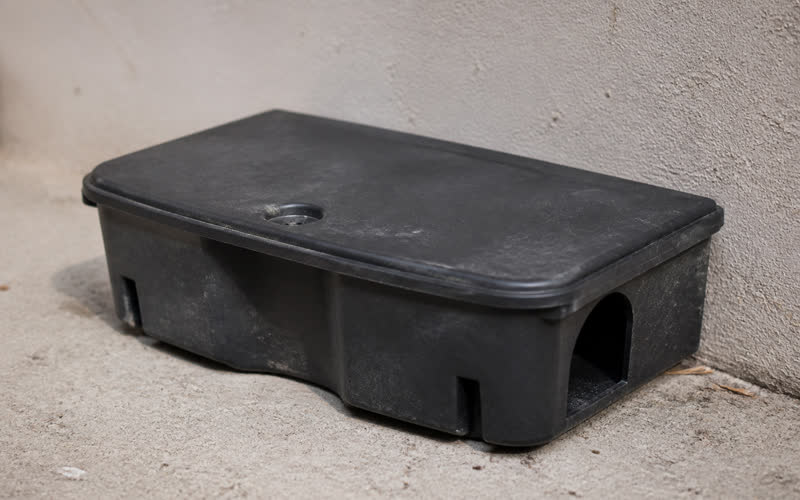
In children's rooms and play areas
In these rooms we use no bait at all. We work with mechanical traps placed where children cannot reach them — behind furniture, in cupboards, in service recesses.
In nurseries and schools
Bait stations go only in plant rooms and around the perimeter. In rooms where children spend time — mechanical traps and monitoring points only. We schedule the work for weekends or the holidays.
What parents need to do after treatment
Nothing in particular: you do not have to leave the premises, wash surfaces or throw food away. The only request is not to move or open the stations — their positions are chosen according to the rodents' runways.
What a child-safe bait station physically is
For many parents the word "station" suggests some sort of little box with poison in it. In practice it is a far more deliberately designed object. The body is impact-resistant plastic, the lid closes with a key or a special catch that is not an ordinary screw and cannot be opened with fingers, a spoon or a hairpin. The entry openings are sized to admit a mouse or a rat but not a child's hand — they are on the sides, low down, and the channel behind them turns rather than running straight. Inside there is a baffle, so even a long object pushed in through an opening does not reach the bait. And the station itself is fixed to the base or the wall so that it cannot be tipped, shaken or carried somewhere else. Each of these features on its own is a small thing. Together they mean a child can get to the station, handle it and even try to open it without ever coming into contact with the contents.
Why securing the bait matters more than any other detail
If you have to judge a station's safety around a child by one feature, it is how the bait is fixed. Professional blocks have a hole through the middle, and inside the station there is a metal rod the block is threaded onto and held on. That changes everything. A rodent cannot pick the block up and carry it away — it has to gnaw on the spot, without leaving the station. It means the bait stays where the technician put it and never turns up under the sofa, the play mat or a child's cot. Most real poisoning incidents in homes happen not because a child opened a station, but because a mouse carried a small heap of pellets to somewhere accessible. A secured block rules that scenario out completely. That is why loose pellets, tipped into a tray or onto paper, have no place in a house with children, however high up they are put.
Doing nothing is not a safe choice either
An honest conversation with a parent starts by comparing two risks, not one. Rodents in a house with children are not a neutral state of affairs in themselves. A single mouse leaves dozens of droppings a day and urinates almost continuously as it moves — across kitchen surfaces, drawers, food packaging and the floor a baby crawls on. Urine and droppings dry out, break down into dust and are breathed in. Rodents also damage electrical wiring and drag nesting material into places where it cannot be seen. A child who spends every day in a room with an active rodent population meets that contamination daily. A controlled treatment with enclosed stations is limited in time and place. An untreated infestation is limited by nothing, and rather than passing on its own, it grows.
A home with a crawling baby is treated differently from one with teenagers
A child's age changes the solution more than the size of the home does. If there is a baby in the house who crawls and puts everything in their mouth, we work on the assumption that everything below sixty centimetres is their territory. That means no stations at all in the living areas — the points move to the technical zones: behind the fitted kitchen plinth, at the ventilation shaft access, at the basement access, in the technical recess on the balcony, in the spaces behind appliances. In a home like this we place mechanical traps only in enclosed, closed-off positions. If there are teenagers in the house, the risk of physical access falls but another one appears — curiosity and the urge to find out what is in there. Then the conversation matters more than the placement. In practice it means we ask the ages of the children before the work and draw up the points afterwards. Not the other way round.
What to tell a child about the stations in the house
Hiding from a child that something has been put in the house usually works worse than telling them. An unexplained box that has been concealed is intriguing; an explained box is boring. With a preschool child a simple, calm wording works: this is the mouse box, it is locked, it is not a toy, and if you notice it has moved or been damaged, tell me. No fear, no emphasis on the word "poison", and no prohibition that sounds like a dare. A school-age child can be told more — that there is a rodent product inside, that it is fixed in place and cannot be removed, and why the box must not be opened. With a teenager it is also worth explaining why the treatment is happening at all: rodents indoors are a hygiene problem. A child who understands the reason leaves the station alone. A child who was only forbidden tends to check.
Planning a nursery treatment and talking to parents
In an institution the technical side is the easy part; the organisation is the hard part. The work has to be scheduled for when there are no children in the building — in the evening after the groups close, at a weekend or during the holidays. Beforehand, two things have to be settled with the management: exactly where the points will go, and which member of staff is responsible for them. Group rooms and dormitories are no place for stations; the points go around the perimeter of the kitchen and the food store, into the plant rooms, the basement, the waste area and the outside surroundings of the building. Parents should be given the information in advance, not afterwards, and in plain language: when, in which areas, why, and what access there is. Experience shows that what worries parents is not the treatment itself, but finding out about it by accident. An institution should also keep a record — a layout of the points, the dates of checks and consumption at each point, so that any later question can be answered with a document.
Mechanical traps in children's rooms — only in closed-off positions
A mechanical trap often seems safer than bait because there are no chemicals in it. In a child's room that is not automatically true. A classic spring trap develops enough force to injure a child's finger badly, and a child's hand is exactly what reaches curiously towards an unfamiliar object. So where children are present, mechanical traps go only where they physically cannot be reached: inside an enclosed trap tunnel, behind a fixed plinth, in a service recess with a closing cover, in the void behind fitted furniture. Never out in the open on the floor along a wall, behind a door or under a bed. The second consideration is the result itself — a dead rodent in a trap has to be removed by an adult with no child present, so trap positions are planned so that checking is quick and done in one pass. In Riga we work evenings and weekends for exactly this reason.
Frequently asked questions
Can children open a station?
No, it is lockable and the entry openings are too small.
Do we have to leave the premises during treatment?
No.
Do surfaces need washing after treatment?
No, the bait is only inside the station.
What should we do if a child has managed to open a station or touched the bait?
Act calmly and quickly. Take the child out of the room, look in their mouth and wash their hands with soap. Even if nothing appears to have been swallowed, seek medical advice immediately rather than waiting for symptoms. Very important: photograph or take with you the bait packaging or the label naming the active substance — it directly affects what the doctor does. Then fill in the form and we will check all the points.
Can a child fall ill from the rodents themselves if we postpone treatment?
Yes, and that is exactly why postponing is not the safe option. Rodents leave droppings and urine on surfaces, on food packaging and on the floor a baby crawls across, and dried contamination ends up in the dust. A population does not shrink of its own accord. A controlled treatment with enclosed stations is limited in time and place; an untreated infestation is limited by nothing.
How low may a station be if there is a crawling baby in the house?
In a home like that I do not place stations in the living areas at all — rodents travel at floor level, so raising a station higher is no solution, it simply will not work. The right answer is a different place, not a different height: behind the kitchen plinth, in service recesses, at ventilation accesses, in the stairwell and the basement. Under no circumstances a point in a child's room.
Can stations stay in place long term if there are small children in the family?
They can, provided they are checked regularly. Long-term control with occasional inspections is safer than a one-off treatment, because at every check the condition of the body and the locks, the bait's fixing on the rod and whether the station has been moved are all assessed. We replace a damaged or moved station. If you notice that a point looks disturbed, fill in the form — in Riga we reply within 5 minutes, weekends included.