
At a glance
- Location
- Ogre
- Service
- Rodent control — rat and mouse extermination
- Price
- From €40 — the figure quoted is the final price
- Availability
- 24/7, weekends and nights included
- Getting there
- We travel from Riga; arrival time agreed per address
- How to book
- Enquiry form only — we reply within 5 minutes
Rodent control in Ogre: two rivers decide where the problem starts
Ogre is a city in its own right and district centre laid out along the Daugava and the Ogre river, and it is the proximity of water that sets the logic of rodent control across the whole town. In the wild the brown rat lives precisely on bank slopes, in overgrown stretches of gully and in the sewer network, so in Ogre it is usually not brought in from elsewhere — it already lives close to the building. A high water table means basements here are damp for most of the year, and a damp basement gives a rat both a water source and a warm place to nest. So rodent control in Ogre almost always starts with an inspection of the basement and the foundation perimeter, not with the flat where the noise was first heard. The Ogre bank and the Daugava bank are, moreover, two separate directions of pressure, and they can be at work at the same time. If the source on the riverbank side is left untouched, treating the upper floors has only a short-lived effect.
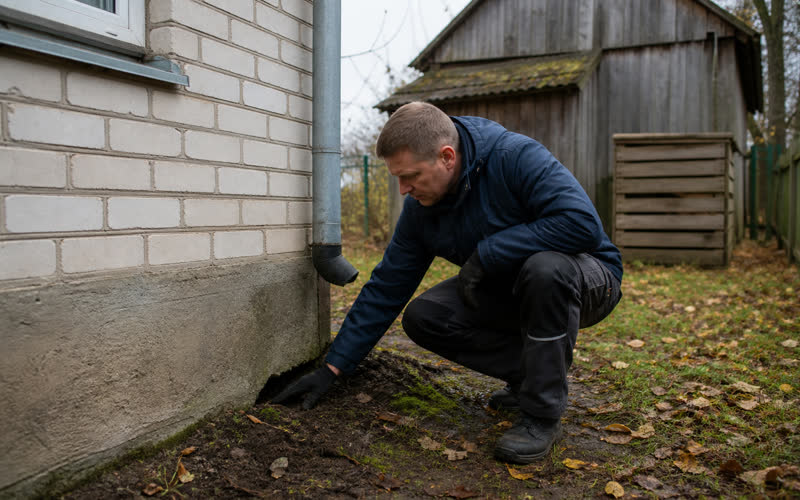
Flooding and heavy rain: why rodents appear suddenly and in numbers
Some areas near Ogre are subject to flooding, and in rodent control that is a concrete rather than an abstract circumstance. When the water level rises, the horizons that flood are exactly the ones in which the brown rat has built its burrows — bank slopes, sections of collector and low-lying yards. The population is pushed upwards and moves into the nearest buildings: basements, sheds, ground floors. The typical picture is a house with no signs at all for years, and then, after a couple of wet weeks, droppings 15–20 mm long turn up in the basement straight away. In such cases speed of response matters: the sooner the entry points are sealed and bait stations placed, the fewer animals manage to settle in. Outside we check for burrow entrances 5–8 cm across along the foundations, under porches and at the drainage outlets, because that is where the population comes back in once the water has dropped.
Hilly, wooded terrain: the forest is your neighbour
The country around Ogre is hilly and wooded, and for many properties the boundary is in effect a forest edge or an overgrown slope. That creates a seasonality less marked in the town centre: in autumn, as the temperature falls, field mice and other rodents from the woodland edge move from the open into warm buildings. A field mouse gets in through a 6–7 mm gap — less than the clearance under a poorly fitting shed door or the gap around an incoming water pipe. For properties on a slope there is a further problem: the foundation level on one side is dug into the ground, and that is exactly where rodents burrow. Mouse extermination at such properties means not only bait indoors but also a check of the perimeter: we cover ventilation openings with metal mesh of 5 mm aperture and seal gaps with mesh and cement mortar.
The apartment districts of Ogre: basement, heating substation and shafts
Alongside its detached houses, Ogre also has Soviet-era apartment districts, and there rodent behaviour is predictable. The building is fed from a single source — the basement or the heating substation, where there is warmth, damp and undisturbed access — while the ventilation shaft and the panel joints serve as a vertical route to the upper floors. A brown rat needs a 20 mm gap and a house mouse 6–7 mm, and both are smaller than the typical clearance around a pipe crossing a slab. That is why treating a single flat in an Ogre apartment block rarely gives a lasting result: the neighbouring spaces are left untouched, and after a few weeks the rodents return by the same shaft. The result holds when at least the whole sewer stack and the basement have been treated with control points whose condition we check at a follow-up inspection.
The historic centre and old timber buildings
Timber buildings survive in the historic centre of Ogre, and for rodents they are the easiest target in the whole town. Timber floor structures, double walls with loose-fill insulation and old foundations with crumbling mortar let rodents move about inside the building in such a way that they never appear in the rooms at all — all you hear is scratching in a wall or a ceiling. For that very reason an inspection looks not only for visible traces but also for greasy smears 5–10 cm above the floor along the bases of the walls: that is an established route the animal uses every night. Expanding foam has often been used in old buildings, but it does not work — rodents gnaw through it within days. A gap can only be sealed durably with metal mesh and cement mortar, and that applies to pipe penetrations and ventilation grilles too.
How we work in Ogre and what treatment costs
Ogre is roughly 34 km from Riga, so we agree the callout by the specific address — we cover both the town and the surrounding Ogre district, including the direction of Ikšķile and Ķegums. We work round the clock, emergency callouts included. Send your request by filling in the form on the website — we reply within 5 minutes. The work starts with an inspection: we identify the species, the areas of activity and the entry routes, and only then plan the bait stations and the sealing of entry points. Prices are final: minimum callout €40, flats €40–80 depending on the number of rooms, private house €90–110, commercial premises from €70. We prepare a written record of the work carried out, useful for the building manager or the person responsible for the site, which allows the condition of the control points to be followed between inspections.
What rodent control in Ogre covers
Rodent control in Ogre means a full cycle, not a single treatment. Rat extermination and mouse extermination start with an inspection: we identify the species, find the runs and the entry points, and only then choose the method. Rodent control involves placing tamper-resistant bait stations or mechanical traps on the actual runs, checking them again, and giving specific advice on what needs sealing so the problem does not come back. The price depends on the type of property and its floor area: treatment starts at €40, and the figure quoted is the final price. Describe the property in the form — we reply within 5 minutes.
Frequently asked questions
Why do rats suddenly appear in Ogre after heavy rain?
A rising water level floods exactly the horizons in which the brown rat digs its burrows — bank slopes and sections of collector. The population is pushed upwards and looks for the nearest dry, warm place, and that is usually a basement. So after wet weeks there are more enquiries, and it is best to book an inspection straight away rather than wait.
How do I tell a field mouse from a house mouse and from a rat?
The most reliable indicator is the droppings: for mice they are 3–6 mm long, for the brown rat 15–20 mm. In the wooded country around Ogre the field mouse turns up mainly in autumn and gets in through a 6–7 mm gap, while a rat needs about 20 mm. Outside, a rat is indicated by a burrow entrance 5–8 cm across along the foundations or under a porch.
Is treating the inside enough for a detached house at the forest edge?
It is not. If a property borders forest or a slope, new animals keep arriving, so rodent control rests on the perimeter: bait stations along the foundations and the outbuildings, plus sealing the entry points. We cover ventilation openings with 5 mm mesh and fill gaps around pipes with mesh and cement mortar.
How long does it take to see a result after bait is placed?
In the first week bait consumption may be low, and that is not a sign of failure — rats show neophobia for 3–7 days, during which a new object in the room is avoided. Mice react faster. At the follow-up inspection we check the consumption at each control point and then adjust the layout of the stations to match the actual runs.