
At a glance
- Service
- Emergency rodent control in Riga 24/7
- Area covered
- Riga and the surrounding region
- Price
- From €40 — the figure quoted is the final price
- Availability
- 24/7, weekends and nights included
- Reply time
- Within 5 minutes of the form being submitted
- How to book
- Through the enquiry form only
Some situations cannot wait until tomorrow: a rat in a restaurant kitchen, rodents in a food store, gnawed cables. In cases like these, speed is what matters most.
We take enquiries at any hour of the day or night, including weekends and at night.
When emergency treatment is needed
If a rodent has been seen in food preparation or retail premises, if electrical cables have been damaged, if activity has increased sharply, or if an inspection of the property is due. For commercial premises these cases affect reputation as well.
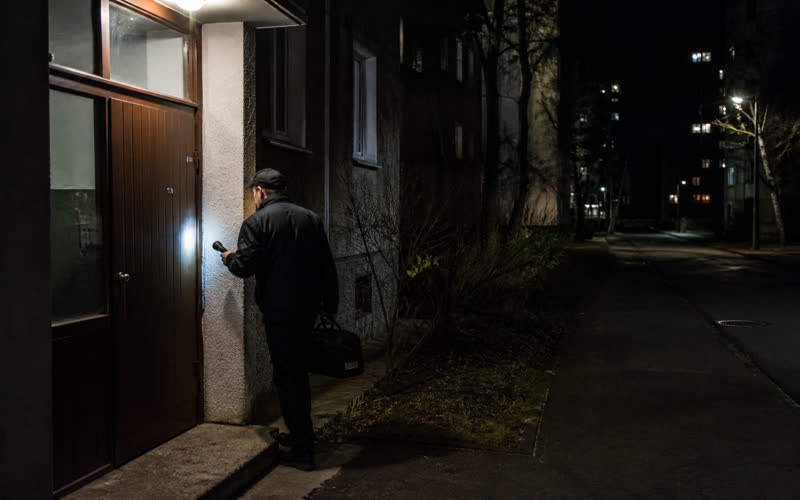
How an emergency callout works
When filling in the form, mark the urgency as "As soon as possible". We reply within 5 minutes, clarify the situation and agree the earliest possible arrival time.
What to do while waiting for the specialist
Put any accessible food into airtight containers, and do not clean up droppings with a dry brush — that lifts dust into the air. Do not try to plug holes with foam; it can change the rodents' routes before the inspection.
What genuinely cannot wait and what can safely wait until morning
The honest answer: not every mouse is an emergency. Emergency rodent control is justified if a rodent has got into a living room and cannot find its way out, if you smell burnt insulation or find gnawed wires, if a rodent appears in a food business during trading hours, if there is a small child in the house and a rodent is moving about the bedroom, or if bait has fallen somewhere a pet can reach it. In these cases every hour changes the outcome. On the other hand, droppings found in a pantry, a chewed food packet in a cupboard or a noise behind the wall at night will generally wait safely until morning — the population has been building for weeks, and a few hours will make no difference. We work 24/7 and we talk nobody out of a night callout, but nor do we press one on you when the situation does not call for it. Describe in the form exactly what you saw, and we will tell you whether a visit is needed now or in the morning.
A rodent in a food business during trading hours: the first steps
A rat seen in a café, a shop or a kitchen during trading hours is a problem that affects reputation as much as hygiene. Step one — cordon off the zone where the animal was spotted and stop work at that spot specifically, not throughout the premises. Step two — take all uncovered produce off the shelves and work surfaces in that section and do not put it back until the surface has been wiped down. Step three — do not photograph and circulate images outside the staff group, but do record the place and time for the internal report. Step four — check the waste area and the delivery doors, since in summer they stand open and are the commonest way in at properties in central Riga. Fill in the form, tick the urgency option and state that the property handles food — we schedule such callouts first and, if you prefer, carry out the treatment after closing. For commercial premises the price starts from €70 regardless of the time of day or night.
Gnawed electrical wiring: why this is a genuine emergency
A rodent's incisors grow throughout its life, so the animal has to gnaw constantly, and cable sheathing is a convenient material. The result is an exposed conductor without the short-circuit protection tripping — and that is the kind of fault that most often ends in a fire inside a partition or a suspended ceiling. The warning signs are a distinctive smell of burnt plastic with no visible source, a light flickering on one circuit, a breaker tripping repeatedly for no obvious reason, and fine accumulations of plastic shavings under a junction box. If you notice even one of them, switch that circuit off at the consumer unit and stop using it. In older Riga buildings with timber floor structures the risk is higher, because the voids between the joists are both a rodent route and a ready-made combustible environment. In this situation a callout is not an overreaction — the problem is the presence of rodents in the structure itself, and it has to be dealt with alongside the electrical repair.
A rodent trapped in a living room: how to contain it safely
When a mouse or a rat is in a room, the natural reaction is to chase it. Do not. A frightened rodent heads for the nearest narrow gap — behind a wardrobe, under a skirting board, into a ventilation duct — and there you will never reach it. Do the opposite: close the doors to the rest of the rooms, block the gap under the door with a rolled-up towel, and leave one route outside if the room is on the ground floor and the window has no screen. Switch off the television and any loud sounds, because in silence the animal moves more predictably. Never pick a rodent up with your hands, and do not treat gloves as a solution — a rat bite is deep and becomes infected. Take pets out of the room, cats especially: an encounter ends in injury for both. Then fill in the form, marking it as urgent. We reply to the form within 5 minutes and agree the arrival time in the course of the conversation.
What to do and what not to do in the hours before the specialist arrives
The two commonest mistakes while waiting are dry sweeping and blocking holes too soon. Never sweep up droppings and nesting material with a dry brush or a vacuum cleaner — the particles rise into the air and the whole household breathes them in. The right way is to spray the surface with soapy water, let it stand for a few minutes and wipe it up with a disposable cloth. The second mistake: do not fill any holes you find with expanding foam or rags before the treatment has taken place. A closed exit route means the animals stay inside the structure and die somewhere unreachable. What is worth doing: put loose cereals, nuts and pet food into hard plastic or glass containers, empty the bin, take up the pet bowls overnight, and photograph the damaged areas. Those photos genuinely shorten the inspection, because the specialist knows straight away where to look.
A night callout in a block of flats: the practical side
Working at night in a Soviet-era apartment block in Riga takes a little planning, but it is not complicated. The treatment itself is quiet — placing control points requires neither drilling nor machinery, so it does not disturb the neighbours. The real obstacle is usually access to the communal areas: the basement, the waste chamber and the riser recesses are often locked at night, and the key is with the building manager or the caretaker. If the rodents are coming from the basement, say so in the form — we will agree what can be done in the flat straight away and what to finish in the morning, when the communal areas are accessible. To get into the stairwell somebody will need to open the front door, or the entry code will need to work. If there are children asleep in the flat, we start the treatment from the furthest room and leave the bedroom until last. In the older buildings of Āgenskalns and Grīziņkalns we also check the loft hatch, because the routes there lead upwards.
Why urgency does not change the price
In many trades a night or weekend callout means a surcharge. In our case it does not, and the reason is simple: being on call 24/7 is built into how we organise our work, not an exception that somebody has to be compensated for. The minimum callout charge is €40 at lunchtime on a weekday and at night on a Sunday alike. For flats the price is €40–80 depending on the number of rooms, for a private house €90–110 depending on the floor area and the basement, and for commercial premises from €70 depending on the floor area and the number of control points. The time of day appears in none of these calculations. The practical benefit is that you do not have to weigh up whether the problem is serious enough to pay more for. If you think it needs dealing with now, describe the situation in the form — the price will be the same as it would be in the morning.
Frequently asked questions
Do you really work at night?
Yes, we take enquiries around the clock.
How quickly do you reply?
We reply to a form enquiry within 5 minutes.
Does an emergency callout cost more?
The price depends on the type and size of the property, not on the time of day. We give the exact sum before the work starts.
How do I mark a case as urgent on the form?
The form has a separate urgency tick — mark it and say in the description exactly what you saw, in which room and how long ago. Enquiries like this go to the front of the queue. We reply to the form within 5 minutes and agree the arrival time in our reply, taking into account the address in Riga and access to the property.
I saw a rat during the day. Does that mean there are a lot of them?
Usually yes. Rodents are active at dusk and at night, so an appearance during the day most often means the night-time feeding places are already taken or the nest is overcrowded. A daytime sighting is not in itself an emergency, but it indicates an established population, and the treatment is better not put off for weeks.
Can you come out on public holidays and at weekends?
Yes. We work without days off or public holidays, and the price on those days is the same as on an ordinary weekday — a minimum callout of €40. Over holiday periods there are more enquiries, so we agree the specific arrival time individually once we have replied to your form.
What should be done with pets before the specialist arrives?
Cats and dogs are best moved into a separate room or taken out for a walk for the duration of the treatment. Collect up the food and water bowls, and afterwards put them back in the places the specialist identifies as safe. The control points we place are tamper-resistant and go where animals cannot reach them, but it is simpler just to keep pets away for the first few hours.