
At a glance
- Service
- Rodent control in apartment buildings
- Area covered
- Riga and the surrounding region
- Price
- From €40 — the figure quoted is the final price
- Availability
- 24/7, weekends and nights included
- Reply time
- Within 5 minutes of the form being submitted
- How to book
- Through the enquiry form only
In an apartment building, treating a single flat rarely solves the problem. If the rodents live in the basement, they will keep moving up the ventilation shafts for as long as the food source exists.
Communal areas
We treat the basement, the heating substation, the stairwell and the bin area — the places where rodents live and breed. Treating flats without that is short-lived.
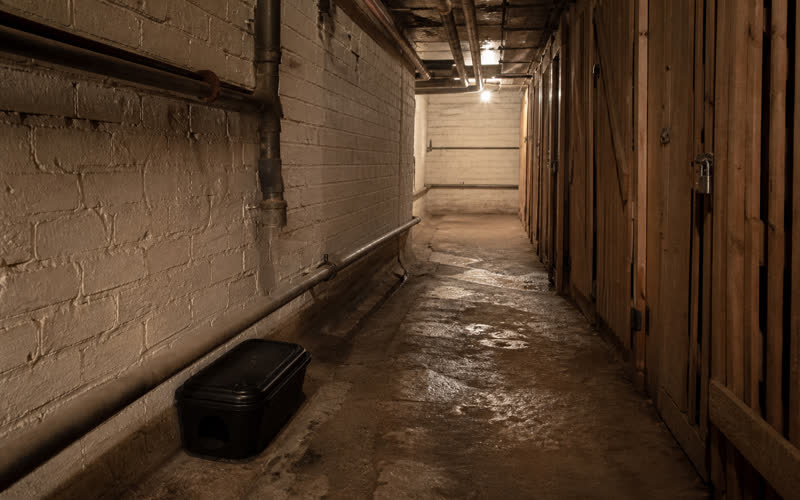
Working with the building manager
We work on instruction from the building manager or the residents' representative. We prepare a written record of the work carried out and a description of where the control points are placed.
Informing residents
Before the treatment we provide brief information on what residents should observe: where the stations will be and why they must not be moved.
Why treating one flat rarely gives a lasting result
In an apartment building, rodents do not live in a flat — they live in the building. The nesting sites are usually in the basement, the pipe shafts, the heating substation or the refuse room, and the flat is only a feeding point at the end of a route. If the treatment happens in one flat alone, two things follow. First, only a small part of the population is affected while the source is left untouched. Second, within a few weeks the vacated ground is taken by animals from the same group, because the route up the riser shaft is still open. The resident sees this as a failed treatment, although the work was done correctly at the wrong scale. In practice this means treating a flat makes sense as part of a building-wide programme, or as a stopgap while the full job is being agreed. Treating a single flat in Riga is usually in the €40–80 range; work in communal areas starts at €70.
The refuse chute and the bin area as the building's main food source
If a building has a persistent problem, the source is almost always at one of two points. The first is the refuse chute and the room at the bottom of it: hoppers on the landings that do not close properly, residue built up on the chute walls, a lidless container at the bottom and a floor that never gets washed. This room supplies food, warmth and cover all at once, and it works all year round. The second is the outdoor bin area: overfilled containers with open lids, split bags, no hard surface underfoot and shrubs right alongside. The practical measures are specific — lids that shut fully, containers on a hard, washable surface, cleaning of the area after every collection, a shrub-free strip at least a metre wide around it, and regular washing of the chute room. While that source exists, any treatment in the building is working against a constant flow of food.
How a whole-building programme is sequenced
A full building treatment runs in a set order, because each step prepares the next. First the inspection: basement, heating substation, pump room, cable and pipe shafts, refuse room, stairwells, loft and the building perimeter, with the findings written down and a plan drawn. Then the basement — the nesting core is usually there, and that is where most of the points go, along the walls and at pipe entries. The third step is the vertical routes: riser shafts, the refuse chute and slab penetrations, with points at every accessible level. Fourth, the stairwells and communal storage. And only fifth come the individual flats where signs have been found; by that stage their number has usually already dropped. Follow-up visits come after that, assessing consumption point by point and adjusting the layout. At every step, what was done and where is recorded.
Resident cooperation: what to report and what not to do
The result depends to a large extent on what residents do. It is worth reporting specifics: which room or floor an animal or droppings were spotted in, what time of day the noise is audible and from which side, where a new hole has appeared in a wall or skirting board, whether the basement door is being left open. This information is worth more than a general complaint, because it lets the points be moved onto the actual route. Four things are best avoided. Do not move or open the stations that have been placed — shifting a point sends the process back to the start. Do not use shop-bought products alongside the programme, because it confuses the record-keeping and creates a risk to children and pets. Do not leave basement and loft doors open. And do not leave rubbish bags in the stairwell or by the door, even overnight.
Practical steps to get the building manager to act
If there is a problem but nothing is happening, what helps is documented fact rather than emotion. The first step is to write down observations with the date, time and place, adding photographs — droppings, gnawing, a hole in a wall, an open container. Second, submit a written request to the building manager rather than a verbal complaint, and keep a copy or the reference number. Third, get the request signed by several neighbours from different floors; a collective submission with evidence from several flats is handled differently from a single phone call. Fourth, ask for a specific reply with a deadline and the scope of work planned, including treatment of the basement and refuse room, not just one flat. Fifth, if the decision needs a vote of the flat owners, prepare the item for the next general meeting. If you need a site description or a cost estimate for the submission, fill in the form — we reply within 5 minutes.
Ground-floor commercial units and their effect on the whole building
A shop, cafe, bakery or food store on the ground floor or in the semi-basement changes the situation for the entire building. The reasons are practical: a constant volume of food, its own bins, frequent deliveries with the doors open, separate ventilation and often its own basement compartment connected to the building's main basement. If the commercial unit is left out of the programme, it acts as a permanent source for the floors above — points in the stairwell and basement only intercept the flow rather than stopping it. So the right approach is to coordinate the work on both sides: the building manager arranges the communal areas, the tenant or owner arranges the commercial premises, and both agree timing so the treatments happen close together. It also matters to check the physical boundary between the spaces — pipe entries, ventilation connections and openings in the basement walls — because that is exactly where the crossing route forms.
Frequently asked questions
Who orders rodent control for a building?
Usually the building manager or the residents' representative.
Does every flat have to be treated?
No. We treat the communal areas first — that is where the source is.
Do you provide documentation?
Yes, a description of the work carried out and the layout of the control points.
Why did the problem come back in my flat after treatment?
Most often because the source is outside the flat — in the basement, a pipe shaft or the refuse room. Treating one flat alone affects only a small part of the population, and within a few weeks other animals take the vacated space along the same route. A lasting result requires work in the communal areas.
What if a neighbour will not allow their flat to be treated?
The programme does not stop because of it. The main work happens in the communal areas and the vertical routes, and that reduces the population throughout the building. An untreated flat remains a weak spot, so on follow-up visits the points around it are reinforced — in the stairwell, in the adjacent flats and along the relevant section of the shaft.
Will closing the refuse chute solve the problem?
It removes one of the main food sources and often brings a noticeable improvement, but on its own it is not enough if a nesting site has already established itself in the basement. The right combination is sorting out the chute and bin area together with treatment in the basement and on the vertical routes.