
At a glance
- Service
- Rodent extermination in Riga
- Area covered
- Riga and the surrounding region
- Price
- From €40 — the figure quoted is the final price
- Availability
- 24/7, weekends and nights included
- Reply time
- Within 5 minutes of the form being submitted
- How to book
- Through the enquiry form only
In everyday use the word "rodents" mainly means rats and mice. In Latvian homes and commercial premises it is in practice always the brown rat, the black rat, the house mouse or the field mouse.
Each species behaves differently, and that is precisely what determines the method. Once the species is identified, the treatment becomes more precise.
Why identifying the species matters
The brown rat digs burrows and travels low down — so we place stations in the basement and along the foundations. The black rat climbs and lives in the loft — completely different places work there. The house mouse stays close to its food source. Getting the species wrong means putting the stations in the wrong places.
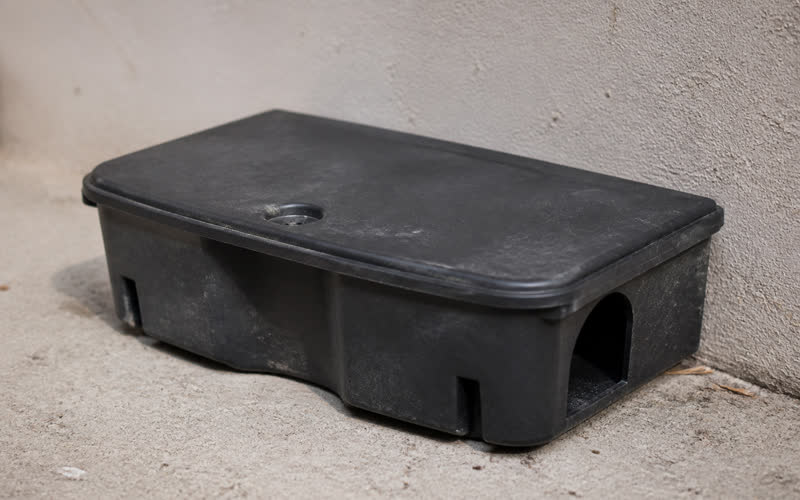
Rodent control on commercial premises
In warehouses, production plants and food premises, rodent control is a continuous process with control points and regular checks, not a one-off treatment.
The damage rodents cause
Rodents damage cabling, insulation, packaging and ventilation systems. Gnawed cable insulation is also a fire risk.
Which rodent species in Latvia actually get into buildings
More than ten rodent species live wild in Latvia, but only five regularly get into human buildings. The brown rat, Rattus norvegicus, is the most common — heavily built, 20–25 cm long without the tail, with a short muzzle, living in basements, sewers and on ground floors. The black rat is less common in Riga and almost always found higher up: in lofts, roof structures and the timber floors of older buildings; it is slimmer, with a tail longer than its body. The house mouse is the permanent indoor resident, 7–10 cm long, with a thin tail and a characteristic sharp ammonia smell near the nest. The field mouse and the wood mouse get in seasonally — in autumn, when the fields have been harvested and night temperatures drop below zero; they tend to stay in the layer of thermal insulation or in outbuildings. The species determines everything that follows: the height of the runs, the type of bait, the size of the stations and how often they are checked.
Why a rodent gnaws even when it is not hungry
The most widespread misconception is that rodents damage materials out of hunger. The real reason is anatomical. A rodent's incisors grow throughout its life — around 0.3 mm a day, roughly 10–12 cm a year. If the animal does not wear them down, the teeth grow so long that it can no longer close its jaws, and it dies. Gnawing is therefore a physiological necessity that happens regardless of the food available. There is a practical consequence: rodents deliberately choose hard materials — concrete render, wood, the sheathing of plastic pipes, aluminium sheet, electrical cable insulation. A brown rat's jaws are strong enough to gnaw through wood, plastic pipes and even thin sheet metal — which explains holes in PVC drainage and bitten-into insulation panels. Removing the food on its own never stops the damage; it only changes where the animal looks for the next hard surface.
The full control sequence: from inspection to monitoring
Professional rodent extermination is a process with seven stages, and none of them can be skipped. First — the inspection: droppings, runs, burrow entrances, grease marks and possible entry points are recorded. Second — identifying the species from measurements, not from impressions. Third — choosing the methods: bait stations, mechanical traps or a combination of the two, depending on the type of site and whether there are children and animals on the premises. Fourth — placement along the actual runs beside the walls, at 5–10 m intervals for rats and 2–4 m for mice. Fifth — follow-up visits, usually at 7–14 day intervals, recording consumption and activity. Sixth — sealing: mechanically closing the entry points with galvanised mesh and mortar once activity has dropped. Seventh — monitoring, which on some sites continues for months with empty control stations.
Why one method almost never solves the problem
Sites where the client has spent a year buying bait from a shop with no result all look like one and the same scenario. There is always part of a population that does not take to a given method. Old, experienced rats avoid new objects and will not touch the stations for weeks. Young animals still feeding on their mother do not take bait at all. Mice, for their part, feed in small amounts in many places, so they do not pass the stations by, but they still take most of their food elsewhere. Use bait alone and you are left with the part that traps would have caught; use traps alone and you are left with those that go round them. That is why a combination works: stations along the main runs, mechanical traps in the tight spots, and removal of the food source at the same time. Then comes the sanitary side — where the bins stand, storage shelving 15 cm above the floor, clean service ducts.
How the size of a population is judged from the signs
An exact number cannot be established, but the order of magnitude can be judged from several indicators. Fresh droppings are moist, shiny and dark; after 2–3 days they turn matt and crumble, and that difference tells you whether the activity is from today or from last month. One brown rat produces 30–50 droppings a day and a house mouse 50–80, so the quantity found over a given area gives an approximate range. The second indicator is bait consumption: if the entire contents of a station disappear night after night at several points at once, this is not one animal. Third — being seen during the day. Rodents are nocturnal; if they appear in daylight, the nesting sites are overcrowded and competition for food is high. Fourth — sounds: scratching at several points in the ceiling or wall at once points to a widespread rather than a local presence.
The rodent year in Riga: what to expect each season
Activity changes predictably, and that allows the work to be planned. In spring, in March and April, intensive breeding begins; a group that has overwintered in the basement can double within a month. In summer some of the animals move outdoors — into the grounds, compost heaps and sheds — and there are fewer signs indoors, which creates the false impression that the problem has resolved itself. In August and September field and wood mice from the surroundings join in. October and November are the peak load of the year: the first frosts drive the whole surrounding population into buildings at once, and that is exactly when most callouts in Riga arise. In winter breeding stops in the wild, but in a heated basement next to the heating substation it continues without a break. The practical conclusion: a preventive inspection in September costs less than emergency work in December, and the result lasts longer.
When the problem is in one building and when it is across the whole block
There are two completely different cases, and they must be told apart before the work starts. If the activity is concentrated in one place — a damaged bin container, a building pit just opened up, a cracked sewer stack — treating the single site is enough. If you treat it, activity falls, but after three weeks it comes back on the same scale, the source is outside the site boundary. In Riga's densely built blocks a brown rat travels within a radius of 50–100 metres in a night, so a neglected basement in the neighbouring building keeps your building occupied indefinitely. The signs that point to this: activity returns from one particular side, the runs lead towards an outside wall or a shared service duct, and several building managers are complaining at the same time. In that case the only solution that works is a barrier treatment around the perimeter plus regular monitoring, not repeated one-off callouts.
Frequently asked questions
How do you tell a rat from a mouse?
By size, droppings and gnaw damage. Mouse droppings are around 3–6 mm, rat droppings 15–20 mm.
Can there be both rats and mice on one site?
Yes, it is not unusual, especially on large sites with a basement.
Does the treatment differ by species?
Yes — the placement, the type of bait and the frequency of checks all differ.
How long does it take before rodent activity starts to fall?
With mice a change is usually visible within 3–5 days, because they accept new objects quickly. With rats the first days can pass with no consumption at all — the animal goes round the stations until it gets used to them. A real drop in activity is judged at the second check, roughly 10–14 days after placement. If nothing has changed by then, the placement of the stations is reviewed rather than their number increased.
Are field mice that come into the house in autumn the same problem as house mice?
No, and the response differs. Field and wood mice come in seasonally in search of warmth and do not usually establish a permanent indoor population — they settle in the insulation, in outbuildings or in partition walls. The house mouse, by contrast, lives and breeds in the building all year. For a seasonal influx the main work is sealing the perimeter and an external barrier; for a permanent population, treatment inside.
Does rodent extermination help if the neighbours do nothing?
It helps, but the effect is shorter-lived. Treating your own site reduces the numbers and stops the damage, but if the source is in the building next door or in a shared service duct, the animals come back within a few weeks. In such cases the practical solution is mechanically sealing the entry points and regular monitoring visits that keep the numbers low, rather than a one-off treatment.
Why is a small problem cheaper to deal with straight away?
Rodent numbers do not grow in a straight line. One pair with steady warmth and food turns within a few months into several nests at different ends of the building, and then you need more treatment points, more visits, and repairs on top — cabling, insulation, stored materials. In a flat the work usually falls within €40–80, in a private house €90–110, on commercial premises from €70. Fill in the form and we reply within 5 minutes.