
At a glance
- Location
- Mārupe
- Service
- Rodent control — rat and mouse extermination
- Price
- From €40 — the figure quoted is the final price
- Availability
- 24/7, weekends and nights included
- Getting there
- We travel from Riga; arrival time agreed per address
- How to book
- Enquiry form only — we reply within 5 minutes
Rodent control in Mārupe: what the shape of the town dictates
Mārupe is a town and a municipal centre growing as a Riga suburb — detached houses, terraced houses, newer apartment developments, offices, warehouses and logistics sites stand literally side by side. That mosaic of building types also shapes how rodents behave: the brown rat travels along ditch edges and utility routes, the house mouse settles into warm structures, and in autumn the field mouse comes in from the adjoining fields. Rodent control in Mārupe is therefore rarely a single callout at a single address — more often it is a matter of rebuilding the logic of the perimeter. We start with an inspection: we look for droppings, grease marks, gnawing and entry holes rather than putting down bait straight away. Without finding the cause, any bait station is just a feeding point, not a solution. Economically, Mārupe combines housing, the airport and aviation services, logistics, offices and retail, so one street can hold both a detached house and a warehouse — and the two need different approaches.
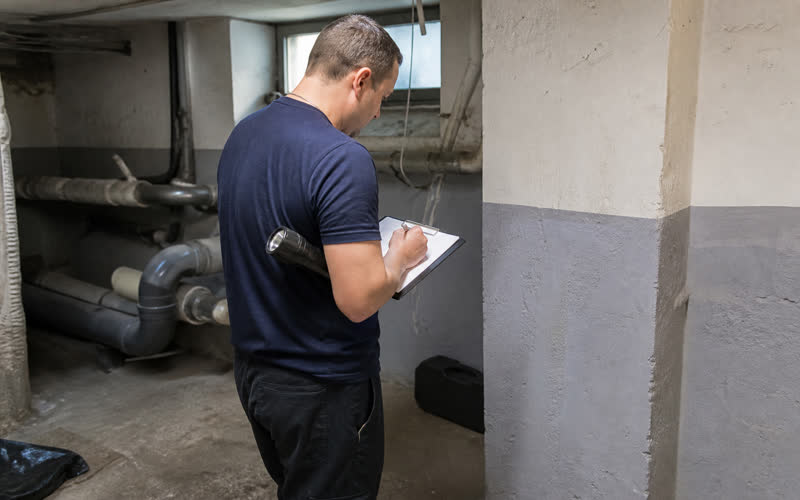
Logistics and warehouses: goods-in as the main route in
In warehouses and logistics sites rodents most often do not arrive from outside at ground level — they are driven in. Pallets, cardboard boxes and packaging from other terminals are a genuine way for the house mouse to travel, and goods-in is the place where it can be spotted first. The second weak point is loading-dock thresholds and the gaps under roller doors: a mouse passes through 6–7 mm, a rat needs only 20 mm, so a worn rubber seal under a door is effectively an open door. Rodent control for businesses in Mārupe is therefore built on a system of numbered control points with fixed positions around the perimeter and across the internal risk zones. At every inspection we record take-up, tracks and any gaps found — a written record of the work carried out stays with the site. For commercial premises prices start from €70, with the scope depending on floor area and the number of points.
New builds: a newly finished house is not automatically protected
A great deal in Mārupe has been built recently, and that is exactly what misleads owners. In a new house we most often find unsealed service entries: water and sewer pipes, electrical conduit, heat-pump runs and ventilation outlets where the installer left an open gap or filled it with expanding foam. Foam does not stop a rodent — a mouse or a rat gnaws through it in a few nights. What works is metal mesh with a 5 mm aperture, set in cement mortar. Sealing entry points is the part that decides whether the problem returns in six months. When inspecting a private house we walk the whole perimeter: plinth joints, air bricks, the bottom of the garage door, the base of the terrace and every pipe entry. Treating a private house costs €90–110, with a minimum callout of €40. Afterwards we hand over a description of the gaps found and the layout of the control points, so the owner knows which places to re-check.
Drainage ditches and the edge of the fields
Mārupe sits on the boundary strip between town and farmland, and that suits rodents well. Drainage ditches and low-lying ground with soft, drained soil are a classic burrowing site for the brown rat — a burrow entrance 5–8 cm across, usually on the ditch bank, under bushes or in a compost heap, a few dozen metres from the house. From there the rat moves along fixed runs, and it is those runs that determine where bait stations work and where they simply stand empty. In autumn the field mouse joins in from the neighbouring fields: as the temperature drops it looks for warmth in outbuildings, sheds and the house basement. For external stations we choose positions along the fence line and the ditch edge rather than the middle of the yard — a rodent moves along cover, not across open ground. If the burrow network on the ditch bank is active, one visit is not enough: we repeat the treatment until tracks and take-up stop, and at the same time seal the entry points in the plinth of the building.
How to recognise the problem before it grows
The signs are measurable, and they tell you what you are actually dealing with. Mouse droppings are 3–6 mm long, scattered across kitchen cupboard shelves, the floor of utility rooms and around the heat-pump unit. Rat droppings are 15–20 mm — usually found in the basement, in warehouse corners or along the base of a wall. On corridor and warehouse walls grease marks are left 5–10 cm above the floor: that is a fixed run, and it shows the route far more precisely than any account of noises. Sounds at night in the ceiling or in a partition wall, gnawed cable insulation, torn packaging in the goods-in area — we record all of these during the inspection and mark them on the plan. The earlier the callout, the smaller the scope of the treatment and the cost. Do not photograph just one spot — write down which rooms show the signs and at what time of day; it speeds the inspection up considerably.
Bait stations, control points and the rat's caution
Rat extermination is not a one-off exercise, because the brown rat shows marked neophobia — it treats a new object in its territory with caution for 3–7 days. That is why a station placed on the first visit is often left untouched, and it does not mean there are no rodents. A repeat inspection a few days later shows the true picture. Mouse extermination goes faster — the house mouse is curious and will investigate a new object on the very first night. The stations are tamper-resistant and fixed in place, positioned along walls, behind equipment, in plant rooms and around the outer perimeter; each is numbered so take-up can be tracked. In flats treatment costs €40–80, and there sealing the shared shafts and stack entries often matters more than the bait itself. In newer apartment developments we also check the underground car park and the bottom of the bin-room doors.
Visits in Mārupe and arranging a time
We serve Mārupe as part of everyday work around Riga — the distance to Riga is 5.7 km, to Baloži 4.9 km, to Olaine 15.2 km and to Jūrmala 18.8 km. Access comes via Kārļa Ulmaņa gatve, the A10, the Riga bypass and the airport approach roads, but traffic is heavy at peak times, and in the newer developments local streets tend to be narrower with variable surfacing. We therefore agree the arrival time separately for each address, and for warehouses and offices we usually plan it outside peak hours or after the working day so that goods flow is not disrupted. We work 24/7 and emergency callouts are available. Fill in the form with the type of property, its floor area and a description of what you have seen — we reply within 5 minutes. We also work in the neighbouring areas, so routes can often be combined.
Frequently asked questions
How much does rodent control in Mārupe cost?
The minimum callout is €40. Treating a flat usually costs €40–80, inspecting and treating a private house €90–110, and for commercial premises prices start from €70 and depend on floor area, the number of control points and how often visits are needed. We set the exact figure once we have a description of the property. Fill in the form and state the type of property and its floor area.
Can rodents really move into a new house?
They can, and in Mārupe it happens regularly. In new builds the service entries are often left unsealed — water, sewer, electrical conduit and heat-pump runs. A mouse passes through a 6–7 mm gap, a rat needs only 20 mm. Expanding foam is no help here; metal mesh with a 5 mm aperture and cement mortar do the job. We check this during the inspection.
How do you tell in a warehouse that rodents came in with the goods?
Look at the goods-in area: gnawed cardboard, torn packaging and 3–6 mm droppings on pallets point to a house mouse that has travelled in with a load. The second thing to check is the loading-dock thresholds and the gaps under roller doors. We assign separate numbered control points to these places and log the data in the written record of the work carried out.
Why is the bait untouched after the first visit?
The brown rat is neophobic — it watches a new object in its territory for 3–7 days before starting to use it. That is a normal process, not a sign that there are no rodents. Mice react faster, often on the very first night. So we plan a repeat inspection and at the same time carry out sealing of entry points to reduce the influx from outside.