
At a glance
- Service
- Rat extermination in basements
- Area covered
- Riga and the surrounding region
- Price
- From €40 — the figure quoted is the final price
- Availability
- 24/7, weekends and nights included
- Reply time
- Within 5 minutes of the form being submitted
- How to book
- Through the enquiry form only
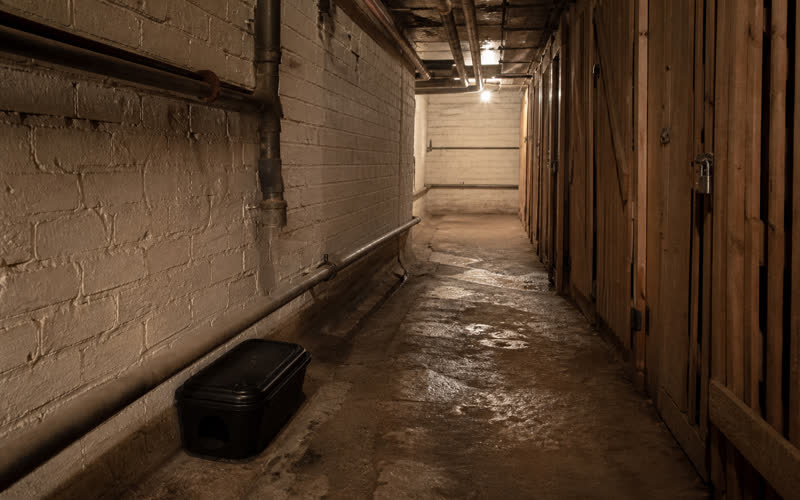
In Riga's older buildings the basement combines everything a rodent needs: heat from the heating substation, damp, darkness, pipe runs and often stored belongings to hide among.
Why the basement in particular
Pipe entries into a basement are almost never sealed. The sewer system is a direct route for the brown rat, and the heating substation supplies warmth all winter.
Storage cages and belongings
Cardboard boxes, furniture and textiles in storage cages are nesting material. During an inspection we always check these areas — that is where the nests are, even when the droppings show up somewhere else.
How we treat a basement
We place bait stations along the walls, at pipe entries and by the heating substation. At the same time we note the gaps that need sealing so the rats do not come back.
A map of the bait stations and their numbering
In a large basement, treatment without a plan turns into guesswork. Before we place anything we draw a simple sketch of the basement — stairwells, heating substation, corridors, rows of storage cages, sewer inspection hatches — and mark every point on it with a number. The stations are labelled physically: a sticker on the lid with the number and the date of placement. In the basement of a typical five-stairwell 512-series block that means eight to fourteen points, spaced roughly ten metres apart along the walls and more densely near the heating substation. The numbering is not bureaucracy. It lets us say precisely, two weeks later, that bait is being taken at points 3, 4 and 11 — all three by the heating main inlet — and that the rest of the basement is clean. Without a map you only know that bait was eaten somewhere. With a map you know where the centre of the colony sits and where the sealing work has to start.
The heating substation and pipe corridors as the main transit network
Rodents do not move around a basement at random — they travel along warm, covered corridors. The heating substation is the hub: a steady temperature all year, condensation on the pipe surfaces and dozens of hidden gaps around fittings and insulation. From there the horizontal pipe corridors run beneath the whole building to every stairwell, while the vertical shafts run upwards. In practice this means bait points belong along the pipe runs, not out in the open parts of the room. We check every place where a pipe crosses a wall or a floor slab, because that is exactly where a polished, dark passage forms. If the basement of a neighbouring building is being renovated or cleared of rubble, the population moves into your building along this same network within a few days. That is why the treatment plan always starts at the heating substation and only then works outwards.
Damp — the reason a basement stays attractive all year
Food sources above ground in Riga change with the season, but water in a basement is constant. A dripping valve, condensation on cold-water pipes, a shaft flooded after heavy rain, an old crack in the sewer — each of these keeps a drinking point alive, and because of it the colony stays put even when food becomes scarce. For a rat, water matters more than food: it can go several days without food, but not without water. During an inspection we always record the damp spots and include them in the report, because they directly affect the odds of reinfestation. If one leaking valve is repaired and one corner dried out after treatment, the next season usually passes far more quietly. Rodents do not settle for long in a dry, ventilated basement with working airflow — they pass through, but they do not build nests.
Working in an occupied building: notice, access and safety
The basement of an occupied apartment building is not an empty plant room — people walk through it every day. Before we come out, we agree with the client that a notice goes up in the stairwells at least a day in advance, so residents know the date and do not leave pets or open food down there. Access to locked storage cages is a separate matter: some cages are locked, and those are often exactly where the nests are. Two things work in practice — the building manager announces a window in which owners open their cages, or the points go into the corridors along the cage mesh and by their doors. Stations are never put in the middle of walkways, by stair treads, or anywhere someone could step on them in the dark. They are lockable, fixed down and set along walls, behind pipe risers and in service recesses.
The follow-up inspection: what we measure at each point
The return visit usually happens after ten to fourteen days, and it is not a formality. At every numbered point we record bait consumption as a percentage, the condition of the station, any damp or rodent signs nearby, and whether the point is still where it should be. The figures show the trend. If consumption was high at six points in the first week and only two in the second, the colony is shrinking and the work is going the right way. If consumption stays level at every point, there is constant pressure from outside — most likely from a neighbouring building or an open sewer inspection hatch — and the plan has to widen beyond the basement. Bait is topped up and damaged stations replaced. Only once consumption reads zero across several consecutive inspections do we advise starting the physical sealing of gaps and entries.
Working with the building manager, and a result for the whole building
One stairwell is not a closed system. The basements of Riga's standard blocks are almost always connected by pipe corridors, so treating only the area under the first stairwell gives a short-lived effect — the colony moves thirty metres and is back within a month. A result that holds comes when the job covers the entire basement level and the building manager sorts out their side in parallel: repairing valves, closing inspection hatches, replacing damaged basement doors and clearing out rubbish accumulated over years. We prepare an inspection write-up with a map of the points and the problem areas marked, which the building manager can use for planning the work and for talking to residents. Treatment of communal areas and commercial premises starts at €70, and that is the final price. The minimum callout fee is €40. To arrange an inspection, fill in the form on the website — we reply within 5 minutes, at night and at weekends too.
Why a basement needs periodic checks
A one-off treatment resolves a specific infestation but does not change the surrounding environment. If the building sits next to a market, a food outlet, a bin area or an old sewer run, the outside pressure is constant and new rats try to get in all year round. On sites like these we recommend a planned regime: permanent monitoring stations in the basement and an inspection every quarter or every two months, depending on what the previous checks showed. Each visit revisits the same numbered points, so over time a consumption history builds up that shows which part of the year pressure rises and which side of the building is the weak spot. This approach costs less than repeated emergency callouts, because the problem is spotted at the first signs rather than when residents can already hear noise behind the wall.
Frequently asked questions
Is treating just the basement enough?
If the source is in the basement — often yes. We also check whether the activity has already reached the upper floors.
How often does it need repeating?
In apartment building basements regular checks are advisable, because the influx from outside keeps renewing itself.
Will the stations get in residents' way?
No, they are compact and set along the walls.
How many bait stations does a medium-sized basement need?
It depends on the floor area, the layout of the corridors and the activity found. In the basement of a five-stairwell block we usually place eight to fourteen points, spaced roughly ten metres apart along the walls and more densely by the heating substation and sewer inspection hatches. We settle the exact number during the inspection, because the pattern of tracks and nests can change the density of the points completely.
Does every storage cage have to be opened for the treatment?
It is preferable, but not always possible. If some cages stay locked, we place points in the corridors along their mesh and by the doors — rodents travel these routes anyway. Even so, if the nest sits inside a locked cage full of cardboard boxes and textiles, the result will be slower, so we suggest that the building manager announce a window for opening the cages.
How is the work carried out documented?
We prepare a basement plan with numbered points, the date of placement and the problem areas found during the inspection — gaps around pipework, sources of damp, damaged inspection hatches. At each follow-up we add consumption figures point by point. This write-up is useful to the building manager both for planning work and for talking to residents.
When can the gaps in a basement be closed up?
Only once bait consumption at the numbered points has stopped across several consecutive inspections. If the entries and hatches are closed earlier, the rodents lose their lower exit routes and move upwards through the heating and sewer shafts to the first and second floors. The right order is always treatment first, physical sealing afterwards.