
At a glance
- Service
- How rodent control works — the process step by step
- Area covered
- Riga and the surrounding region
- Price
- From €40 — the figure quoted is the final price
- Availability
- 24/7, weekends and nights included
- Reply time
- Within 5 minutes of the form being submitted
- How to book
- Through the enquiry form only
The result of rodent control depends on how precisely the first steps are carried out. The inspection and the identification of entry points determine everything else.
- 1
Inspection
We inspect the property and establish where the rodents shelter, travel and feed. Without an inspection, treatment is guesswork.
- 2
Finding entry points
We locate gaps, pipe entries, ventilation openings and other places through which rodents get inside.
- 3
Assessing the scale
We assess how large the population is and how long it has been there — this determines the method and the intensity of treatment.
- 4
Choosing the method
We choose the solution for the specific situation: lockable bait stations, mechanical traps, or a combination of the two.
- 5
Placement
We place bait stations and traps where the rodents actually move — not where it is most convenient.
- 6
Removing the cause
We give specific recommendations for sealing gaps, pipe entries and ventilation openings so the problem does not return.
- 7
Control and monitoring
We return to check the result, replace what has been used up and monitor whether the activity has stopped.
What happens between filling in the form and the first visit
The rodent control process starts earlier than the moment a specialist comes down the stairs. Once you have filled in the form we reply within 5 minutes, and the first step is a few clarifying questions: where exactly the signs were noticed, how long they have been observed, whether droppings, gnawed packaging or scratching sounds at night have been seen or heard. We also ask about the type of building — a Soviet-era apartment block, a renovated building in the centre, or a private house with a basement. This information is not bureaucracy: it determines what equipment the specialist puts in the van and how much time is set aside for the site. If rats rather than mice are suspected, larger tamper-resistant stations have to be prepared for the visit. After that we agree a time. We work around the clock in Riga, so an inspection can be scheduled late in the evening or at a weekend if nobody is at home during the day.
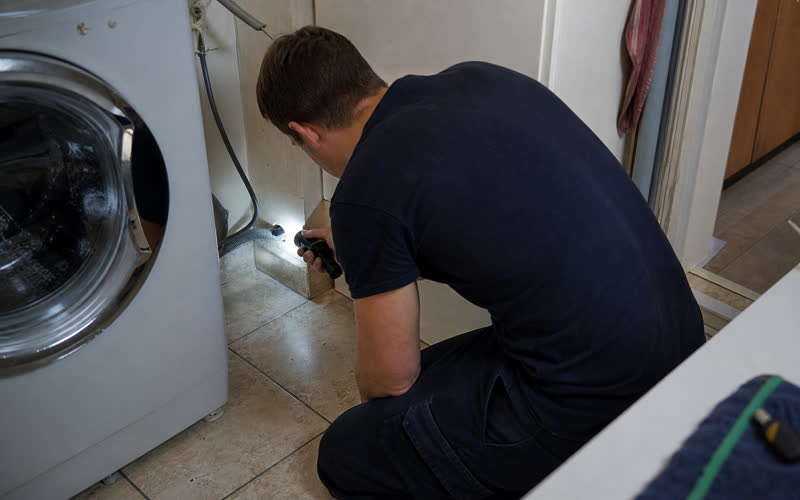
The first twenty minutes on site, and why the order matters
On arrival, the specialist does not start by putting out bait — at first they simply walk around and look. The room where the signs have been noticed most often is inspected first, then the adjoining rooms, and only after that the technical areas: the basement, the ventilation shaft, the recess around the sewer stack, the space under the sink and behind the cooker. This order is not accidental. If bait is placed straight away in the first visible spot, there is a real risk it will sit outside the rodents' actual runs and go untouched for weeks. During the inspection we look for three things: fresh droppings, greasy rub marks along the base of the walls, and entry points — gaps around pipes, the damaged edge of a ventilation grille, a crack in the foundations. Only once this map is clear is it decided how many points are needed and where they will go.
What the client is asked to do after the treatment
After the treatment the client's role is small but important. The first request — do not move or open the bait stations, even if it seems they would look better somewhere else. The points are placed according to the runs we found, and a station that has been shifted effectively means a week lost. Second — write down any new activity: the date, the place, exactly what you noticed. At the follow-up visit these notes are more valuable than anything else. Third, and the most counter-intuitive — do not seal the gaps we have found straight away. While the treatment is under way the entry points must be left open, so that rodents keep moving along the routes they know and visit the control points. Sealing is the last step, not the first. We also ask you not to do a deep clean in the areas where points have been placed, and to move food into airtight containers for the time being.
How the follow-up check differs from the first visit
The follow-up check usually takes place after seven to ten days and looks quite different. It is shorter and more focused: the specialist does not survey the site afresh but goes straight to the points that were placed and reads the data. They assess how much bait has been taken at each station and whether new droppings have appeared outside the known runs. If one point has been emptied completely while the rest are untouched, that means the centre of the activity is closer to it, and the points are rearranged. If the whole system is untouched and there are no new traces, that is already a good sign. It is often at this visit that an entry point comes to light that was not visible the first time, because a week of animal movement leaves clearer traces than a single evening.
How the process adapts to a home with children and pets
In an occupied flat with small children or a dog and a cat the approach changes, and we agree on that in correspondence before the visit. The main principle is mechanical inaccessibility: the product sits in a lockable station that cannot be opened by hand, and the station itself is placed where a child or an animal physically cannot get to it — behind fitted kitchen units, in a ventilation recess, under the bath panel. Where there is nowhere to place a tamper-resistant point, preference goes to mechanical traps, which work without any product at all. We explain to the client where each station is so it can be worked around when cleaning the floor. If there is a hamster or a rabbit in the house, you must tell us — the plan is then drawn up differently.
What the process looks like on commercial premises
On commercial premises rodent control work is more formalised. Each control point is given a number, marked on the site plan and physically labelled on the spot, so that any member of staff or inspector understands what it is. In a shop, a café or a warehouse the points are placed around the whole perimeter, by the entrance doors, in the bin area and in the technical rooms, not only where traces have been noticed. At each visit we record what was found at each number, and these entries build up the site's history. That shows whether the activity is concentrated in one and the same place — which often points to a specific structural problem. On sites that operate at night or without days off, we schedule the work outside visitor hours. For commercial premises the price starts from €70 and is calculated from the floor area and the number of points.
When the process ends and what a resolved situation looks like
The process does not end with a mouse no longer being seen. Visibility is a weak indicator — rodents are active at night and stay unnoticed most of the time even when the problem is serious. We consider a situation resolved at the point when there has been no consumption at the control points for several weeks running, no new droppings have appeared, there is no fresh gnaw damage on packaging or wiring, and traces of activity have stopped in the area that was previously the busiest. Only then does it make sense to seal the gaps found around pipes and ventilation openings, because at that moment sealing becomes a way of keeping rodents out rather than shutting them in. After that it is worth keeping at least a couple of control points as monitoring — they do nothing while all is well, but they show a return far earlier than the eye does.
Frequently asked questions
How long is the wait for a specialist?
We reply to an enquiry within 5 minutes and agree the earliest available time. We work 24/7.
Is the inspection a separate service?
The inspection is part of the treatment. The minimum callout is €40, and it includes looking over the site and assessing the problem.
Do you come back after the treatment?
Yes. A follow-up check is part of the process — without it there is no way of knowing whether the activity really has stopped.
How long should I expect the whole rodent control process to take?
In a typical flat the cycle lasts two to three weeks: the first visit, a follow-up check after seven to ten days and a closing assessment. A private house or commercial premises usually takes longer, because the area to be treated and the number of entry points are greater. The duration is set by the activity at the control points, not by the calendar.
Do we have to move out of the flat during the treatment?
No. The control points are placed enclosed, and go in places you do not use day to day — behind fitted furniture, in ventilation recesses, under sanitaryware panels. Both children and pets can stay in the flat. Tell us about them in the form so that the layout plan is drawn up accordingly.
Why must the holes we have found not be sealed straight away?
While the treatment is under way, the entry points are also the runs by which rodents reach the control points. Sealing them too soon leaves the animals inside looking for new routes that nobody knows about. The gaps are sealed after activity at the points has stopped.
What should I do if I notice something again after a few days?
Write down the date, the place and exactly what you saw or heard, and fill in the form with that description. It is not a sign of failure — in the first days activity often even increases, because the rodents start moving about more. This information helps to fine-tune the placement of the points at the follow-up visit.