
At a glance
- Topic
- Rat droppings — how to identify them
- Signs
- Droppings, grease marks, gnawing, noise
- Mouse gap
- From 6–7 mm
- Rat gap
- From 20 mm
- What fixes it
- Inspection, bait stations or traps, sealing entry points
- How to book
- Enquiry form only — we reply within 5 minutes
Droppings are the only sign that shows the species, the location and how old the problem is all at once.
What rat droppings look like
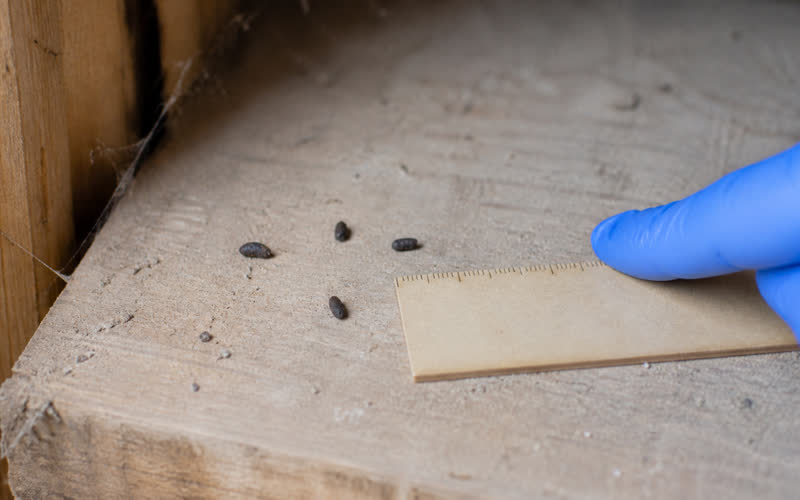
Rat droppings are 15–20 mm long, dark and elongated with rounded or pointed ends. The brown rat's are broader with blunt ends; the black rat's are thinner and more curved.
The difference from mouse droppings
Mouse droppings are 3–6 mm — roughly the size of a grain of rice. If you find both sizes, both species are present on site, and that changes the treatment plan.
Fresh or old
Fresh droppings are soft, dark and shiny. After a few days they turn greyish, dry and crumbly. If everything you find is dry and crumbling, the activity may already be over.
How to clear them up safely
Never sweep up dry droppings with a brush or a vacuum cleaner — that lifts particles into the air. Put on gloves, spray the surface with disinfectant, let it work and pick everything up with a damp disposable wipe.
Mapping droppings: finding the nest by density
A single find tells you little, but a map of all the finds points to the nest fairly precisely. Take a plan of the building or the flat, or simply sketch the layout on a sheet of paper. Walk through every room with a torch and, at each place where you find droppings, mark a cross and the number: one, a few, dozens. Rats leave droppings everywhere they travel, but the concentration rises sharply closer to the nest and the feeding site. If you find five in the hallway, twenty behind the kitchen cupboard and a hundred at the foot of the basement stairs, the direction is clear. The density gradient almost always leads to a warm, dark, undisturbed void — a crack in the foundations, a pipe shaft, old insulation. This map is the most valuable thing you can prepare before an inspection, because it saves several hours of searching.
Rodent droppings versus those left by other animals
Not every dark pellet on the floor is a rodent's work, and misidentifying it changes the whole solution. A rat dropping is 15–20 mm long, about 5–6 mm wide, evenly cylindrical, with rounded ends or a point at one end, and it stays hard and uniform once dry. Bat droppings are a similar size but crumble completely to powder when pressed with an object, and consist of fine shiny particles — you only find them under attic gaps or the roof overhang. Pine martens leave much larger, twisted, irregular deposits, often with hair or fruit stones in them, and these are usually in one specific spot rather than scattered along a run. Bird droppings are soft, with a white uric acid part. If the crush test turns the sample to powder, or you can see hair, it is not a rodent case.
What a find on a high shelf tells you compared with one on the floor
Where the droppings are found identifies the species just as well as their size does. The brown rat is a low-level animal — its traces are skirting boards, the basement, the bottom shelf of a cupboard, the space behind the fridge and the area around sewer pipes. If every find is at floor level and within the first 20 cm of height, the brown rat theory is strong. The black rat, by contrast, is a climber: it travels upwards along pipes, cables and wall voids, so it leaves traces on top cupboard shelves, attic floors, above suspended ceilings and on roof structural members. Mouse droppings are 3–6 mm long and thin as a grain of rice, and you find them at both levels, because a mouse is light and climbs freely. So note the height in centimetres — it affects where the control points go.
How to photograph a find properly for the inspection
A photo without a scale is close to useless, because distance and size cannot be judged from an image. Put a coin, a ruler or a key next to the find and only then take the picture. The second requirement is side lighting: hold the torch almost parallel to the surface so the shape and surface texture come out, not just a dark smudge. Take three frames — a close-up with the scale, a mid shot showing the surface or shelf, and a general shot that makes clear which corner of the room is involved. Do not move or clean the find before photographing it. Note the date, the floor and the room. These three photographs together with a sketch of the layout make it possible to prepare a precise plan of work before the visit and shorten the inspection on site.
Why counting is a poor guide to population size
A common question is how many animals a given quantity of droppings indicates, and the honest answer is that counting does not settle it. One animal that has lived in the same place for a week leaves more evidence than five rats that passed through a room for a single night. The quantity depends on how long they have been there, how much food there is, the temperature and how often the room is cleaned. On top of that, some of the material ends up in wall voids and never appears anywhere visible. In practice three other things tell you much more: how many separate places in the building are affected, how fresh the newest finds are, and how quickly new ones appear after a thorough clean. Two or three affected rooms on different floors point to a more serious situation than a large quantity in one corner.
Protective equipment: exactly what you need and how to use it
A few specific items are enough for the clean-up, but they have to be used in the right order. You need disposable nitrile gloves, a face mask that fits closely around the nose and chin, and ideally a simple overall or clothing that can go straight into a 60-degree wash afterwards. Never start with a brush or a vacuum cleaner — dry sweeping lifts dust into the air, and that is exactly what you want to avoid. First open a window and air the room for at least 15 minutes, leaving the room empty. Then wet the material thoroughly with water and detergent, let it soak in for five minutes, and only then pick it up with a damp paper towel. Put the waste in a bag, tie it, and put that inside a second bag. Take the gloves off last and then wash your hands with soap. If you feel unwell after cleaning, see a doctor.
Frequently asked questions
Are rat droppings dangerous?
They can carry disease organisms, so work with gloves and a damp method.
How many droppings does one rat produce?
Up to 40 a day, so quantity is not evidence of a large population.
What should I do if I find them in a food cupboard?
Throw out any opened products, wash the cupboard out and book an inspection.
How can I tell where the nest is if the droppings are in several rooms?
Mark every find on a sketch of the layout and note the approximate number. The nest is where the density is highest, because along the runways the animals leave only isolated pellets. The density gradient usually leads to a warm, undisturbed void — a crack in the foundations, a pipe shaft or old insulation.
Can the number of rats be worked out from the quantity of droppings?
Not accurately enough. The quantity depends more on how long they have been there and how available food is than on the number of animals. Far more is told by the number of affected rooms, how fresh the newest finds are and how quickly new ones appear after a thorough clean. Those three pieces of information are worth noting down before you fill in the form.
Are all the small dark pellets in the attic rat droppings?
No. Bat droppings are a similar size but crumble into a shiny powder when pressed. Pine martens leave considerably larger, twisted deposits, often with hair in them. A rat dropping is 15–20 mm long, hard and evenly cylindrical. Test with an object rather than your fingers, and wear gloves.