
At a glance
- Topic
- Noise in the ceiling and wall at night
- Signs
- Droppings, grease marks, gnawing, noise
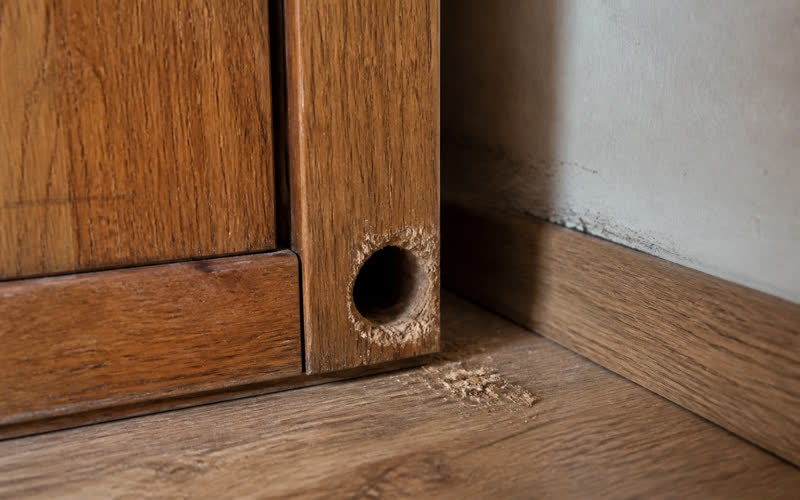
- Mouse gap
- From 6–7 mm
- Rat gap
- From 20 mm
- What fixes it
- Inspection, bait stations or traps, sealing entry points
- How to book
- Enquiry form only — we reply within 5 minutes
The noise usually starts in the evening, around the time the house goes quiet, and carries on in bursts all night. It is one of the first signals people notice.
What the noise tells you about the location
Noise in the ceiling usually means the loft or the floor void between storeys. In a wall — the cavity of a stud partition or a ventilation shaft. Under the floor — the void in the floor structure. A sound that moves vertically is almost always a shaft.
Mice or rats
Mice make a light, quick rustle and fine scratching. Rats make heavier, slower steps, sometimes with audible dragging or rolling of objects. If the sound feels "heavy", it is most likely a rat.
Could it be birds or pine martens
Birds are active by day, not at night — night-time noise almost always rules birds out. A pine marten makes noticeably louder, heavier noises in a loft, often with growling. If the sound is very loud, it may not be a rodent at all.
Why you need to act quickly
Noise means a nest has already been built. Every week the population grows, and with it the risk of damage to cables and insulation.
A noise diary: three columns that speed up the diagnosis
A week of notes gives you more than an hour-long inspection. On a sheet of paper or on your phone, set up three columns: time, place and duration. Every time you hear the noise, write down the exact time to the minute, the room and which part of the wall or ceiling it came from, and how long it went on — a few seconds, a minute, a quarter of an hour. In a fourth column, describe the character briefly: rustling, gnawing, rolling, heavy steps. After five or six nights, patterns appear that memory can never reconstruct. If the noise starts every evening an hour after dark and always from the same side, you are dealing with a permanent nesting site. If it turns up irregularly and in different places, the animal may only be passing through the building. These notes are the most concrete thing you can attach to an enquiry.
Why the sound misleads you about the location
In ceilings and floor voids, sound does not spread evenly in all directions — it travels along timber joists, metal profiles and pipes, which act as conductors. As a result, a noise made above the living room can be heard best in the bedroom, because that is where the joist rests on the wall and the sound radiates from the bearing point. Pipe runs and ventilation shafts likewise carry sound between floors, so noise from the loft sometimes sounds as though it is coming from a wall on the first floor. The practical answer is triangulation: listen to the same noise from two or three different rooms and note where it is loudest and where it seems higher or lower. Better still, get a second person listening in another room at the same moment. The place where the sound is both loud and clear is usually the one nearest the source.
The knock test and the reaction to it
A simple test that separates a living creature from a structural noise. When you can hear the noise, knock lightly but sharply on the ceiling or wall with your fist or the end of a wooden handle. A live animal almost always reacts: the sound stops completely for a moment, then there is often a rapid movement away from where you knocked, and a few minutes later the noise resumes somewhere else. A structural noise — pipes clicking, timber contracting, wind — does not react to the knock at all and continues at the same rhythm. If the sound stops and then moves, that is one of the surest signs of a living presence. Note which way the movement went, because it points towards the hiding place. The test can be repeated in different spots to map out the boundaries of the occupied area.
Rodents, pipes, timber movement or wind
Each cause has its own signature. Rodent noise is irregular: short bursts of movement, pauses, movement again, sometimes something being rolled or dragged, and it usually starts after dark. Pipes give a metallic clicking or hissing that is directly tied to the heating firing up or water being used — check whether the noise coincides with heating cycles or with the neighbours' shower. Timber contracting produces isolated loud cracks with nothing following them, more often in the evening and the morning, when the temperature changes quickly; they never form a sequence of movement. Wind noise changes with the weather — check whether it disappears on still nights, and look at the roof flashing, the downpipe and the ventilation cowl. If the noise turns up equally on warm and on still nights, the animal explanation is what remains.
Pine marten or rat — and why it changes the solution
The difference is audible. A rat is small and light: the steps are fine and quick, movement comes in short darts, gnawing is high-pitched and intermittent, and you often hear rolling as it shifts something small. A pine marten weighs several kilograms and it sounds like it — separate heavy steps that the structure visibly responds to, long dragging sounds as insulation is moved about, sometimes scraping and even howling or growling. A pine marten is mainly active in the evening and early morning, rats all night. The second clue is location: a pine marten is almost always in the loft or the roof structure, not in the partition wall of a flat. The distinction matters, because a pine marten is a wild animal covered by separate rules and handled by different specialists; rodent treatment will not help here. So describe the weight and rhythm of the sound before you send an enquiry.
Top-floor flat and private house — different scenarios
On the top floor of a block of flats, noise in the ceiling almost always means the service floor or loft above the flat, and that is communal space. Treatment inside your flat will only help in part, because the nest and the entry point are outside it — so at the same time tell the building manager, so that the inspection covers the loft, the roof accesses and the ventilation cowls. On middle floors, ceiling noise more often comes from the floor void or a riser shaft, and here it matters to find out whether the neighbours have signs too. In a private house the situation is entirely in your hands and the checks are more direct: inspect the loft with a torch, check the roof overhang and eaves from outside, look at the condition of the ventilation outlet grilles, and at any tree branches reaching the roof. Treating a flat in Riga usually costs €40–80, a private house €90–110.
Frequently asked questions
Why is the noise only audible at night?
Rodents are nocturnal and avoid human activity.
Will the noise go away on its own?
No. It means there is a permanent nest.
How do I pin down the exact spot?
By the direction of the sound at night, and by droppings and gnaw marks during the day.
Why does the noise seem to come from a different room than it really does?
Sound travels along joists, metal profiles and pipes, so it radiates from bearing points rather than from where it is made. Listen to the same noise from two or three rooms and note where it was both loud and clear — that is usually the point nearest the source.
How do I check whether the noise is coming from a live animal?
Knock lightly on the ceiling or wall while the noise is happening. A living creature almost always falls silent, then moves off quickly and starts up again somewhere else. Pipes clicking, timber contracting and wind noise do not react to the knock and carry on at the same rhythm.
How do I tell a pine marten from a rat by sound?
A pine marten weighs several kilograms — you hear separate heavy steps, long dragging sounds and sometimes howling, mainly in the evening and early morning, and almost always in the loft. A rat's steps are fine and quick, with movement in short darts all night. A pine marten calls for different specialists.