
At a glance
- Topic
- Rats and mice in winter
- Signs
- Droppings, grease marks, gnawing, noise
- Mouse gap
- From 6–7 mm
- Rat gap
- From 20 mm
- What fixes it
- Inspection, bait stations or traps, sealing entry points
- How to book
- Enquiry form only — we reply within 5 minutes
A common misconception is that cold weather solves the problem. In fact rodent activity indoors is at its highest in winter, because outside there is neither food nor warmth.
Where rodents spend the winter
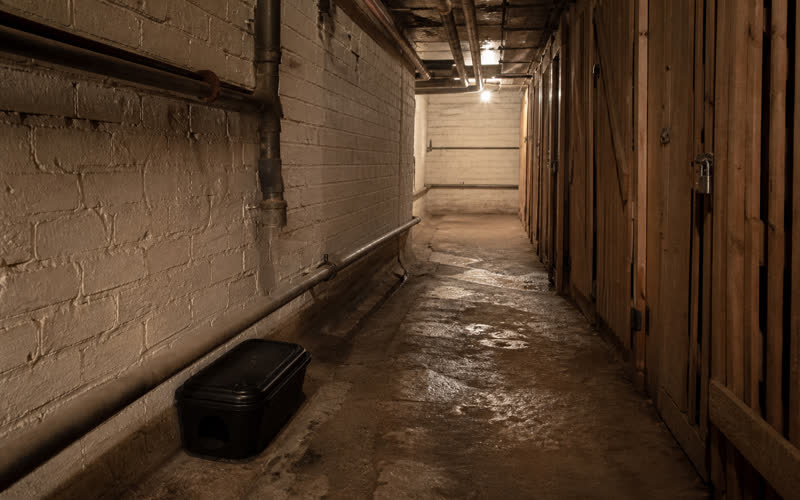
In basements near the heating substation, in insulation, in partition walls, in lofts and around heating mains. Any place with steady warmth becomes a nesting site in winter.
Why they become more noticeable in winter
The population concentrates into a smaller area, and the noise becomes easier to hear. That is why many people notice the problem in winter, even though it started in the autumn.
Searching for food
In winter rodents take more risks: they come into kitchens and pantries even when people are about. A rodent seen during the day in winter usually means the population is already large.
Treatment in winter
Treatment in winter is effective, because the rodents are concentrated indoors and the runs can be identified clearly.
Warm pipes and heating mains as winter routes
In winter, rodent movement through a building follows the heat. The heating substation, the heating risers, the hot water circulation loop and the lagging on the pipes form a continuous, warm, hidden corridor from the basement to the top floors. Pipe penetrations through floor slabs are exactly the places where a 3–5 cm gap has been left around the pipe in the concrete, and in winter it is used every night. Outside the building, heating mains and service ducts play the same role: snow melts over them sooner, and circular routes form there running from one building to the next. In a winter inspection, then, the first job is to follow the warm lines rather than walk through the rooms one by one. A practical sign is small channels gnawed into the pipe lagging and a worn, dark band along the outside of it. Where that band ends, there is usually a nest.
Why winter is in fact a good time to treat
There is a widespread assumption that nothing needs doing in winter and that you should wait for spring. In practice the opposite is true, for three reasons. First, the population is concentrated: living outside the building is no longer possible, so all the animals are in a few warm places, and control points there reach almost the whole group. Second, there is little competing food — no compost, no fallen fruit, no garden waste — so the bait is no longer competing with an easier source and feeding starts sooner. Third, the routes are clear: the warm mains and dry runs are limited, and the animals have no alternative. At the same time breeding is slower in winter, so a reduced population does not build itself back up within a few weeks. In practical terms, a treatment carried out in January often gives a more durable result than the same treatment in July.
Snow as a diagnostic tool
Fresh snow cover is the best free inspection tool of the whole year. On the night after a snowfall every track on the site has only just been made, and in the morning you can see exactly what would otherwise have to be guessed at. A rat's trail is roughly 4–7 cm wide, with a visible tail drag mark down the middle — that mark is a reliable sign. Mouse tracks are finer, and mice often bound, leaving groups of four prints with gaps between them. The routes tell you even more: a beaten path through the snow leading from a bin to a gap in the foundations shows the exact line along which stations should be placed. In winter, burrow entrances give themselves away by frost or a melted patch around the hole — you can see the warm air coming out. If you spot tracks like these, photograph them with something beside them for scale and describe the direction in the form.
Riskier behaviour when there is no food outside
In winter the need for calories rises while the number of available sources falls. The result is a change in behaviour that clients notice as a sudden worsening of the problem. Animals start coming into rooms they have never been in before; activity appears during the day; neophobia decreases, and a new station is visited on the first or second night rather than after a week. At the same time the risk of damage grows — packaging that was never touched before gets gnawed, and the chance of damage to electrical wiring rises as the animals look for a way into the warmest niches. The practical conclusion for a householder: a sign that appears in winter is no less serious because it is cold. It usually means the resources available in the surrounding area have run out and that this particular building has become the main target.
What to check in an unheated outbuilding
A garage, a shed, a sauna or a summer house is especially risky in winter, because nobody is there but there is cover. The checklist is short and practical. Start with machinery: move the lawnmower, the chainsaw and the car, and look at the cable insulation and the air filter housing — a nest in the engine bay is a frequent find. Then stored belongings: cardboard boxes, mattresses, tarpaulins, old blankets; any shredded material in a corner is a sign of a nest. After that, dry food — vegetables, seed, animal feed — which should be moved into metal containers with a tightly fitting lid. Finally the structure: a gap under the door of more than 6 mm, cracks in the rubber seals on the doors, ventilation openings without mesh and cracks in the foundations. In winter it is worth doing this check once a month — an unvisited building hides the problem until spring, by which time the damage is done.
Getting ready before the first frosts
Work done in October is not needed again in November. Preparation has four parts. First, outside food sources: close the compost, pick up fallen fruit, raise the bird feeder and clear underneath it, and make sure bin lids close fully. Second, the perimeter: cracks in the foundations, ventilation hatches, pipe entries and gaps under doors should be sealed with metal mesh or a seal, because mice get through a 6–7 mm gap and rats through about 20 mm. Third, firewood and materials: stacks should be moved at least a metre from the wall and lifted off the ground. Fourth, control: putting external stations around the perimeter before the cold sets in, so the animals are intercepted on their way to the building rather than once they are already inside. If you would like to plan this preparation, describe the property in the form — we reply within 5 minutes, and we work in Riga around the clock.
Frequently asked questions
Does the cold kill rodents?
No. They move indoors.
Is treatment effective in winter?
Yes, often even more effective, because the population is concentrated.
Why are they seen more often in winter?
Because they are looking for food and stay closer to where people live.
Is it worth starting treatment in winter at all, or is it better to wait for spring?
It is worth starting straight away. In winter the population is concentrated in the warm places, there is no competing food, and the routes are narrow and clear — all of which speeds up the result. Waiting until spring means that by March the group will have survived and started a new breeding cycle in greater numbers.
What should I do if I notice tracks in the snow around the house?
Photograph them before the snow drifts over, and note where they lead from and to. A trail with a tail drag mark down the middle points to rats. Tracks show the exact route, so this information is worth more than any description from memory. Fill in the form and add your description — we will plan the inspection around it.
Can rodents even survive in an unheated summer house in winter?
They can, and that is often exactly where they overwinter. Heating is not necessary — cover, dry conditions and nesting material from mattresses, blankets and cardboard boxes are enough. The animals find food in what is stored there or bring it in from around the property. An empty building is not a safe building.