
At a glance
- Page topic
- What to do if there are mice in the house
- Area covered
- Riga and the surrounding region
- Price
- From €40 — the figure quoted is the final price
- Availability
- 24/7, weekends and nights included
- What works
- Metal mesh with a 5 mm aperture and cement mortar; expanding foam does not
- How to book
- Enquiry form only — we reply within 5 minutes
If you have just spotted a mouse or droppings, the next few days decide whether it stays a small problem or grows into a large one.
First steps today
Move all food into metal or hard plastic containers. Clean up the crumbs behind the cooker and the fridge. Take the rubbish out. Look through the kitchen cupboards and note where the droppings are — that shows the centre of activity.
What not to do
Do not sweep droppings up dry and do not use a vacuum cleaner — that puts particles into the air. Do not plug holes with expanding foam — mice chew through it. Do not put poison out in the open if there are children or animals in the house.
Over the next few days
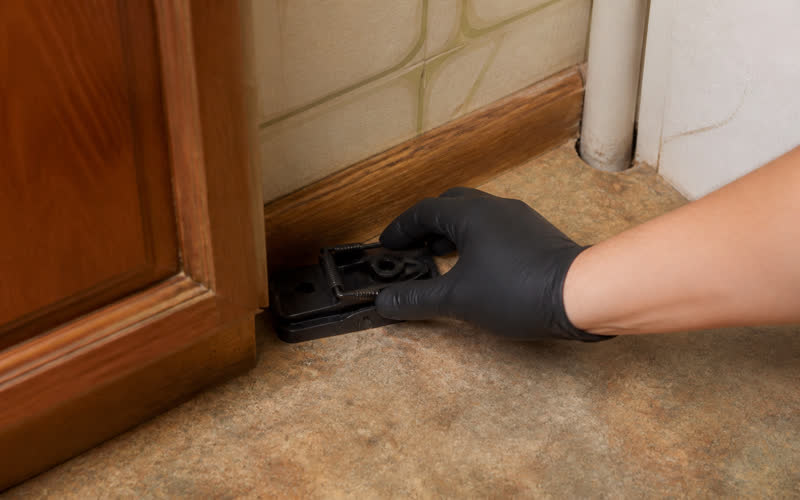
Set 3–4 traps along the walls where the activity is. Check the gaps around pipework and ventilation. Seal everything larger than 6–7 mm with steel wool or mesh.
When to call in a specialist
If droppings still appear after a week, if mice are visible during the day, if noise comes from a wall or ceiling, or if you live in an apartment block and the source is outside your flat.
What counts as an emergency here and what does not
First, keep calm. A mouse in the kitchen is not an emergency — it is a household job with a clear solution that takes a few days of systematic work. You do not need to leave the house, throw out the whole kitchen or sleep at a friend's. Urgent action is genuinely needed only in a few cases: if there is a smell of burning or power goes off at particular sockets, which can indicate damaged wiring; if there is an infant or a seriously ill person in the house and rodents are getting into the bedroom; if you find extensive, fresh damage to cables or pipes. In every other case the plan is this: secure the food tonight, set traps tomorrow, and find and close the entry points within the week.
How to protect food and dishes tonight
A specific list for this evening. All dry food — cereals, flour, pasta, sugar, nuts, crackers, pet food — decant into glass jars or thick plastic boxes with tight-fitting lids. Paper and thin film packaging is no protection. Put fruit from the table into the fridge or a closed container. Wipe crumbs off the work surfaces, take the crumb tray out of the toaster, clean behind the cooker and the space under the fridge. Do not leave dirty dishes in the sink overnight and do not leave damp cloths out — water matters to a rodent as much as food. Dishes and cutlery standing on open shelves in an area with visible signs of activity should be washed in hot water with detergent before use.
What to tell the children
Children react to an adult's tone more than to the facts. Say it simply and without drama: a small animal has got into the house, we are going to deal with it, and there are a few rules. There are three rules. First — never touch a rodent with your hands, alive or dead; if you see one, call an adult. Second — do not touch or move the traps and boxes the adults have put out. Third — do not take food into your room or leave it under the bed; that is actually a useful rule after the problem is solved too. With older children you can explain why removing the food is the most important part — then the rule stops being arbitrary. If there are small children in the house, choose enclosed traps with an opening only a rodent can reach.
Check the car and the shed as well
A rodent that has got into the house almost never stops there. A car standing in the yard or in an unheated garage is one of the most surprisingly common places to find damage — open the bonnet and look for leaves, strips of paper, dry grass or grains of dog food carried in for a nest. Check the air filter housing and the cabin filter area too. In the shed and the basement, look at stores of seed and vegetables, bird food, the bottom of the dry firewood stack, old furniture upholstery. Move seed and feed into metal or thick plastic containers. If there are signs of activity in several buildings, you are dealing with an outdoor population, and the work has to start outside rather than in the kitchen.
A short observation log that pays off
Write it down. A note on your phone or a sheet of paper on the fridge is enough. Each day record the date, the room, what you saw — fresh droppings, gnawing, noise, the animal itself — and how many were caught. Photograph the damaged spots and the droppings before you clean them up. This record gives you three things. First, you can see objectively whether things are improving instead of going by feel. Second, if you rent or live in an apartment block, a dated record with photographs is the only serious argument in a conversation with the landlord or the building manager. Third, if a specialist does turn out to be needed, the information shortens the inspection and makes it possible to work in the right places straight away.
What changes if the flat is rented
For a tenant the order of actions is different. Do not delay reporting it — inform the landlord in writing, by email or text, as soon as you find the signs, and include dates and photographs. Written contact matters because it fixes the timing. Do not carry out work affecting the structure on your own — drilling holes, removing finishes, opening a wall — without agreement; securing food, cleaning and setting traps, on the other hand, are entirely up to you and should start this evening. If the source is in the basement, the stairwell or the ventilation shaft, that is common property, and the solution sits with the building manager. If a site assessment is needed, fill in the form — we reply within 5 minutes.
Frequently asked questions
Is one mouse a problem?
It is almost never on its own.
How fast do they breed?
Very fast — the offspring are sexually mature in six weeks.
Should a specialist be called in straight away?
Not always. With a small problem you can try it yourself first.
Should food that was nearby be thrown away?
Throw out anything in chewed or torn packaging, and anything opened from a shelf where droppings were found. Untouched, airtight packaging and tins can be kept after wiping the outside. Wash dishes and cutlery from that area in hot water before use.
Is it safe to sleep in a room where you hear rustling at night?
Yes. Mice do not approach people and will not climb onto the bed at night — they avoid open space and move along the walls. Keep food in the room closed, do not leave food on the bedside table and shut the door if the activity is in the next room. There is no need to move where you sleep.
How quickly can a specialist come if the situation is urgent?
In Riga we work around the clock, including urgent callouts. Fill in the form, giving the district of the address, the type of premises and what you have observed so far — we reply within 5 minutes and agree the earliest possible time. The minimum callout is €40, a flat treatment €40–80, a private house €90–110.