
At a glance
- Topic
- Rats in a neighbour's flat or in the stairwell
- Signs
- Droppings, grease marks, gnawing, noise
- Mouse gap
- From 6–7 mm
- Rat gap
- From 20 mm
- What fixes it
- Inspection, bait stations or traps, sealing entry points
- How to book
- Enquiry form only — we reply within 5 minutes
In a block of flats, rodents do not recognise the boundaries between flats. They move through ventilation shafts, pipe runs and partition walls — and settle wherever there is food.
How to tell the source is elsewhere
If activity returns within a few weeks of treatment, if droppings appear only by the ventilation or the pipework, and if the neighbours are complaining too — the source is outside your flat.
What you can do in your own flat
Seal the gaps around pipework, replace the ventilation grille with fine-aperture metal mesh and remove sources of food. That will not deal with the source, but it stops them getting in at your place.
How to handle it for the building as a whole
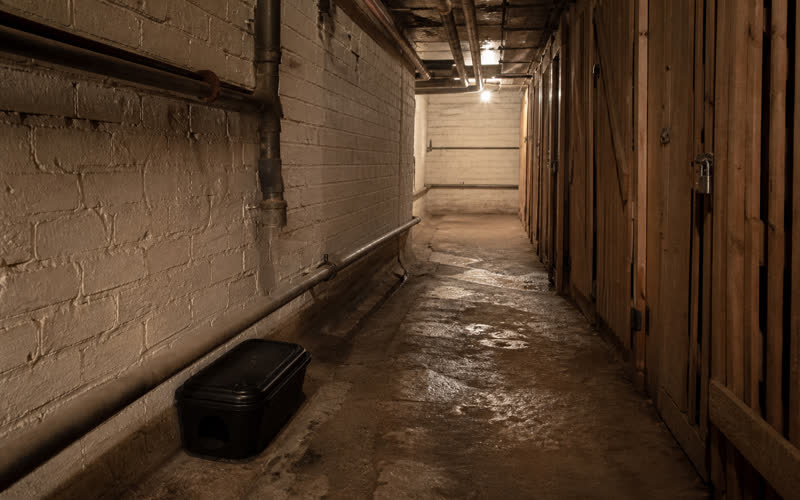
Inform the building manager or the residents' representative. Treating the common areas — basement, stairwell, waste storage — is the building manager's responsibility, and that is usually what solves the problem for the whole building.
Why coordinated treatment is cheaper
If only one flat is treated, the rodents move to the next one and come back later. Treating the common areas and problem zones at the same time costs less than repeat callouts.
How to raise it with a neighbour without a row
A conversation about rodents easily turns into an accusation, because people take it as a remark about how clean they are. So start with yourself: say that there are signs in your flat and that you are trying to work out where they come from. Not "you've got rats", but "I've got a noise in the wall we share". Offer a joint check — most people agree if they are not being blamed. If your neighbour denies any signs at all, do not argue: ask whether you may sprinkle a thin layer of flour by the pipe entries in their kitchen for one night. It is a small request, and the result speaks for itself. A calm, specific tone achieves more here than pressure.
How to write a request the building manager can act on
A complaint reading "there are rats in the building, do something" usually ends up at the bottom of the pile. A request containing facts is dealt with faster, because the manager can see the scale of it straight away. Give specific dates and approximate times when you heard or saw something; exact locations — the ground floor of the stairwell by the meter cupboard, the basement corridor under the third entrance, the bin area; and exactly what you found — droppings, gnawing at the bottom of a door, grease marks along the base of a wall. Attach dated photographs. Finish with a clear request: to inspect the basement and the common areas and to carry out treatment. Send it in writing and keep a copy.
What evidence to gather over two weeks
Two weeks is enough time to turn a suspicion into material someone can work with. Write one line each day: date, time, place, what you heard or found. Photograph droppings next to something for scale — a coin or a matchstick; that makes it possible to say afterwards whether it is mice or rats. Clean one spot completely and check it two days later: fresh droppings in the same place mean an active run, not old history. Note which side of the wall or floor the sound is louder on. Write down what you did yourself as well. A log like this saves time during the inspection and makes the conversation with the manager far more concrete.
Why partial treatment moves the problem rather than solving it
A rodent colony lives in the building, not in a flat. It uses the basement, the service shafts and the stairwell as a network of routes, but looks for food wherever it can find it. If one flat is treated, the rodents simply move to the next available place — often exactly one floor up or down. A couple of weeks later the neighbour complains, then you do again. The result is that the building pays several times over for separate treatments and the problem goes nowhere. The only thing that works is acting at the same time: the basement, the stairwell, the bin area and the flats with signs, all in one go. In Riga this is the most common reason a building fights the same problem for years.
Ground-floor commercial units as a frequent source
Many Riga buildings have a shop, a café, a hairdresser or a small workshop on the ground floor. There you get food waste, cardboard packaging, a warm storeroom and often a separate entrance from the courtyard that stands open during the day. If rodents appear on the upper floors of the building, it is worth looking downwards first. The signs that point that way: bins standing overfull or without lids, cardboard piling up behind the building, ventilation outlets without mesh, basement doors opposite a storeroom left open. This is not worth pursuing through an argument — what usually works is a conversation with the manager so that the inspection covers the commercial units and their waste area as well.
Frequently asked questions
Who pays for treating the common areas?
It is usually covered out of the building's maintenance charge.
Can I treat only my own flat?
You can, but if the source is outside, the result will be short-lived.
What if my neighbour does nothing?
Go to the building manager — the common areas are their responsibility.
How long should I gather evidence before going to the manager?
Two weeks is enough if you make notes every day. That already gives you dates, places, photographs and a clean-and-check test showing the run is active. If the signs are pronounced — a rodent seen during the day, or gnawed food packaging — do not wait two weeks, report it straight away.
Does my neighbour need to know I am submitting a request?
Not necessarily, but it is almost always better if they do. In the request you are describing the situation in the building, not accusing a particular flat, and your neighbour will find out anyway when the inspection is announced. Telling them beforehand avoids the feeling that something is going on behind their back and makes working together afterwards easier.
What if the signs are only in the stairwell and not in my flat?
That is the best moment to act, because the rodents have not yet found their way in. Note down and photograph what you find in the stairwell, submit it to the manager, and in the meantime check the gap under your door, your pipe entries and your ventilation grilles. Closed entries at this stage usually protect a flat completely.