
At a glance
- Topic
- Rats in the sewer and the toilet bowl
- Signs
- Droppings, grease marks, gnawing, noise
- Mouse gap
- From 6–7 mm
- Rat gap
- From 20 mm
- What fixes it
- Inspection, bait stations or traps, sealing entry points
- How to book
- Enquiry form only — we reply within 5 minutes
This is one of the few situations where people's fear is entirely justified: a rat really can move up a sewer stack and swim out through a toilet trap.
How it is possible
The brown rat swims and can hold its breath for several minutes. A sewer stack is a vertical tunnel with dry walls above the water line — to a rat it is a route, not an obstacle.
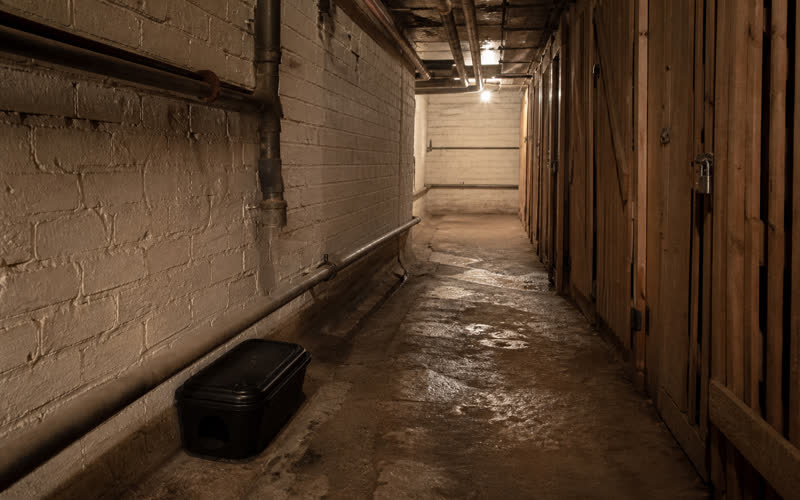
What to do if a rat is in the toilet
Do not open the lid and do not flush repeatedly — that can force the animal out into the room. Close the lid, put a weight on it and book a specialist. Do not try to catch it yourself: a rat bites when defending itself.
How to prevent it
The solution is a sewer non-return valve, which lets flow pass in one direction only. In older buildings one is often not fitted. The second step is checking that the stack and the inspection hatch are properly sealed.
Why the problem comes back
If there is damage to the building's sewer connection or an open inspection point in the basement, rats have permanent access. Treatment without fixing that defect will only give a short-lived result.
Old cast-iron and clay stacks in Riga
In much of Riga's centre and pre-war building stock, sewer stacks are still cast iron, while below ground under the building they are ceramic — clay pipes with cement joints. Both materials develop the same problem over time. Cast iron corrodes from the inside, the wall thins, and a hole or crack forms at a joint. A ceramic pipe does not rot but is brittle: groundwater movement, frost heave and tree roots push sections out of line, leaving an opening at the joint. A rat needs an opening of roughly five centimetres to squeeze through, and the soft ground around the damaged spot lets it dig a chamber right beside the pipe. So in houses where the stack has not been replaced for thirty years or more, the problem is usually not the non-return valve but the condition of the pipe.
A building problem or a street problem
This distinction determines who does what, so it is worth establishing first. A building-level problem shows up locally: the sounds and signs are in one stack, within one or two flats, often on the lower floors, and droppings or damp track marks are visible in the basement by the inspection hatch. A street-level problem shows up more widely: in several stairwells or several neighbouring houses at once, often after street works, sewer flushing or a nearby demolition — the colony loses its usual route and scatters along the connections. If the same symptoms appear in the house next door in the same week, treating one flat will not solve it; the work has to cover the whole building connection and the basement, and the building manager should be informed so they can notify the network operator.
What a plumber checks and what a rodent specialist adds
With a drain camera, a plumber runs a probe down the stack or the outgoing drain and records where there is a crack, a displaced joint, root ingress or an unsealed old connection from a kitchen that no longer exists. The recording shows the exact distance in metres from the inspection hatch, and that allows the right spot to be dug up rather than the whole run. The rodent specialist works with what the camera does not show: establishing whether the damage is actually being used, by inspecting the basement, the shafts and the service entries, placing tamper-resistant bait stations on the colony's side and monitoring consumption over several weeks. In practice both steps are needed together — repair without treatment pushes the animals onto a neighbouring route, and treatment without repair means new ones arrive within a few months.
Dried-out floor gullies and a lost water seal
Every gully and trap has a water seal — a U-shaped bend holding water that physically separates the room from the pipe. If the water evaporates, the seal disappears and an open pipe is left. This happens exactly where water is rarely used: a summer house, a basement shower, a utility room, a second bathroom, and in a rented flat that has stood empty for two months. In summer heat a seal can dry out in three to four weeks. The sign is simple — a sewer smell comes from the gully although there is no blockage. So is the solution: pour about a litre of water into the gully every two weeks, and in a rarely used spot add a spoonful of vegetable oil, which slows evaporation. In the long run, gullies with a dry-trap membrane, or simply a metal cover that seals, do the job.
Smells that point to a damaged joint
Smell is the cheapest diagnostic tool there is. If a sewer smell appears and fades depending on how much water the neighbours are using, or gets stronger in windy weather, it points to an open joint rather than a blockage. If the smell comes from a wall or a crack in the floor rather than from a sanitary fitting, there may be a damaged section of stack behind the finishes. If the smell is noticeable only in one corner of a room and gets stronger by the skirting board, the place to inspect is under the floor, not the bathroom. An additional sign is a damp, dark patch on the render where a pipe enters. Places like this are rodent entry points at the same time — where air and smell pass through, an animal can come through too.
Which section is the building's responsibility and which is the flat's
In a block of flats the boundary is usually simple. The vertical stack, the basement drain run and the outgoing drain up to the first manhole are common parts, looked after by the building manager and paid for out of the building's maintenance funds. The horizontal branch from your sanitary fitting to the stack, the traps, the gullies and the toilet connection are the flat owner's part. What that means in practice: if a rat came out of the toilet, the cause is almost always in the common parts, and only a written request to the building manager will get the basement and the stack inspected. Write a request with the date, the floor, a specific description and photographs, and ask them to record whether other flats have the same. If several flats are affected, a joint request is dealt with faster.
Frequently asked questions
How often does this happen?
Rarely, but in Riga's older building stock with ageing sewers such cases are known.
Does a non-return valve solve the problem?
It is the main technical solution against entry via the sewer.
Is a rat in the toilet dangerous?
It can bite if you try to catch it. The best thing is to close the lid and call in a specialist.
Does flushing out the sewer get rid of rats?
High-pressure jetting cleans out deposits and scares the animals off temporarily, but it does not close the entry point. After a few days they come back through the same crack. Jetting is useful as preparation for a camera survey, because damage is visible in a clean pipe, but on its own it does not solve the problem.
How do I tell whether a rat is coming from the sewer or the ventilation?
The sewer route is marked by damp track marks by the toilet, the gully or under the sink, a sewer smell and noise at night in the bathroom. The ventilation route gives dry scratching noises up high, at the ceiling or behind the kitchen grille. If the signs are low down and damp, inspect the pipework and the basement inspection hatch, not the ventilation grille.
What should I do first if a rat is already in the flat?
Close the room doors to limit where it can go, put the toilet lid down and a weight on top of it, and do not start chasing the animal with a broom. Remove any accessible food and water. Then fill in the form on the website — we work around the clock in Riga, reply within 5 minutes and can attend an emergency callout.