
At a glance
- Page topic
- Mouse traps — types and placement
- Area covered
- Riga and the surrounding region
- Price
- From €40 — the figure quoted is the final price
- Availability
- 24/7, weekends and nights included
- What works
- Metal mesh with a 5 mm aperture and cement mortar; expanding foam does not
- How to book
- Enquiry form only — we reply within 5 minutes
Mice travel along walls and avoid open ground. A trap in the middle of a room stays untouched even when the room is full of mice.
Types of trap
The classic spring trap is effective and acts quickly. Enclosed traps are safer in homes with children. Live traps need checking every day and the animal taking at least several kilometres away. Glue traps are inhumane and not advisable in most situations — the animal dies slowly.
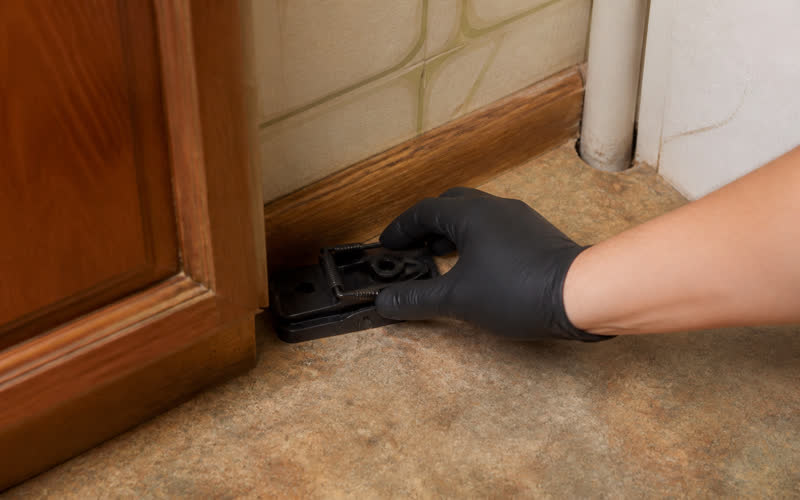
Where to place them
Along walls, with the working end towards the wall, behind furniture, at gaps in the skirting and at pipe runs. Space traps 2–3 m apart. The place matters more than the bait.
What bait works
Peanut butter, chocolate or oat flakes work better than cheese — mice go for fatty and sweet food. A quantity of bait larger than a pea lets a mouse take it without setting off the mechanism.
The commonest mistakes
Too few traps (a single room needs at least 3–4), handling traps with bare hands, placing them out in the open, and skipping the sealing of entry points.
How to set a snap trap safely without catching your fingers
Most injuries from a mechanical trap happen at the moment of setting it. The sequence is simple. First put the bait on the trigger plate while the trap is still unset — that keeps your hands out of the strike zone. Only then pull back the metal bar, hold it with your thumb and hook the catch. Hold the trap by the edge of the base, not over the mechanism. Put it down with both hands and draw your fingers away sideways, not across the trigger. If the trap fires empty in your hands, do not try to catch it in mid-air. Work somewhere well lit, not in a dark niche behind a cupboard. If there are children or pets in the house, choose enclosed plastic designs where the mechanism can only be reached through a mouse-sized opening.
Gloves, scent and the myth of mouse wariness
A commonly heard piece of advice is to set traps only while wearing gloves so the mouse does not pick up human scent. As far as house mice go, that is much overstated. Unlike rats, mice are not neophobic — they will investigate a new object in their territory on the first or second night. That is exactly why mouse traps often go off straight away, while with rats you have to wait several days. Gloves do have another, more practical purpose: they protect you from contact with droppings, urine and nesting material, and that is the main hygiene risk in this job. Always use disposable gloves when handling a trap that has fired. Do not store traps together with fuel or household chemicals — strong industrial smells genuinely do repel mice, unlike the scent of your hands.
How to read a trap that has fired but is empty
An empty, fired trap is information, not a failure. There tend to be three causes. First, too much bait, or bait placed loosely, so the animal took part of it from the side while standing outside the strike zone; the fix is a pea-sized portion pressed into the hollow of the trigger. Second, the trap is out in the open and the mouse approaches from the front. The trap should stand at right angles to the wall with the trigger towards the wall, so the animal comes along its own route and its head ends up under the bar. Third, the mechanism is set too stiff and only fires under a full body weight. Check whether the trap fires at a light touch on the trigger with a pencil. If empty catches keep repeating, move the trap 30–50 cm along the same wall, not into another room.
Live traps and the honest part about releasing
Choosing a live trap carries an obligation that many people do not think through. A captured animal in a small box without water dies of stress and dehydration within a few dozen hours, so such traps may only be used if you check them at least once every twelve hours — morning and evening. If you are going away for the weekend, the traps have to be collected in, not left working. The release site is the second question: a house mouse comes back from a few hundred metres away, so a realistic distance is at least two or three kilometres from occupied buildings. It also needs saying, though it is often left unsaid, that a large proportion of released house mice die in unfamiliar territory anyway, because they are not adapted to life outside a building. It is a humane solution only in part.
Why glue traps are a bad choice
Glue boards are still on sale, but in practice they are the worst method available. A stuck animal does not die quickly — it stays alive for hours, trying to pull free, and often injures its limbs. There are purely practical drawbacks too. Dust, building debris and nesting material stick to the glue, after which the surface no longer works: in a basement or a renovation area a board becomes useless within days. A pet's paw or a child's hand can also get stuck, and freeing them is difficult. On top of that, you have to decide yourself what to do with a live, stuck animal. A mechanical snap trap with correctly adjusted sensitivity is faster, cleaner and more predictable.
How many nights without a catch means the job is done
One rodent caught means nothing — a building rarely holds a single animal. The criterion is an unbroken run of empty nights with the traps set and baited. In practice we treat the situation as finished after seven to ten consecutive nights without a catch, provided the traps have been in the right places throughout and the bait has been refreshed every two or three days. Counting starts from the day of the last catch, not from the day you set the traps. Watch the indirect signs alongside: fresh dark droppings, new gnawing on packaging, rustling at night. If a single fresh sign appears after seven empty nights, the traps are in the wrong place. Finish by sealing every opening wider than six millimetres, otherwise it all starts again in a few weeks.
When traps are no longer the right tool
Traps work in one specific situation: a small population, clear travel routes, accessible spaces. Outside that their effectiveness falls sharply. If six or more animals are caught over three or four nights and the catches do not stop, you are dealing with a breeding population that multiplies faster than you can catch it. The second case is rodents in wall voids, ceiling voids or a ventilation shaft, where there is simply nowhere to put a trap. The third is the basement and stairwell of a block of flats, where the source is in common property and treating one flat solves nothing. The fourth is shops, cafés and warehouses, which need a systematic scheme of control points. In cases like these, fill in the form describing the type of premises and how many animals you have caught already. We reply within 5 minutes and work in Riga around the clock.
Frequently asked questions
How many traps are needed?
At least 3–4 in one room, placed along the walls.
Is cheese a good bait?
No. Peanut butter and chocolate work better.
Why do the traps not go off?
Most often the wrong place, or too few of them.
Can a trap be left set if there is a cat or dog in the house?
An open snap trap — no. A dog's muzzle or a cat's paw can get into the strike zone, and injury is a real possibility. Use enclosed plastic designs with a mouse-sized opening, or put open traps only under fitted furniture and in rooms the pet cannot get into.
How often should the bait be changed if no trap goes off?
Every two or three days. Peanut butter dries out and loses its smell, seed mixes get dusty, dried meat hardens. With dried-out bait you are no longer testing the location, just waiting. When you change it, clean the old residue off the trigger too, so the new portion holds well in the hollow.
Can the same trap be used again?
Yes. Clean off the old bait residue and check that the bar has not bent and that the trigger still fires at a light touch. If the mechanism starts sticking or the base has cracked, replace the trap — a worn trap fires with a delay and produces exactly the empty catches you are trying to avoid.
Why do the traps catch in the kitchen but never in the bedroom?
That shows where the food source is. Mice travel set routes along walls between the nest and the food, and the bedroom is often off that route. Do not rush to take the traps out of there — move them along the wall, behind the headboard or at the base of the wardrobe, where there is cover.