
At a glance
- Topic
- Rats in the basement — what to do
- Signs
- Droppings, grease marks, gnawing, noise
- Mouse gap
- From 6–7 mm
- Rat gap
- From 20 mm
- What fixes it
- Inspection, bait stations or traps, sealing entry points
- How to book
- Enquiry form only — we reply within 5 minutes
If droppings have been seen in the basement, movement can be heard or there is a sharp smell, the rats are most likely already nesting there rather than just visiting.
Why rats choose the basement
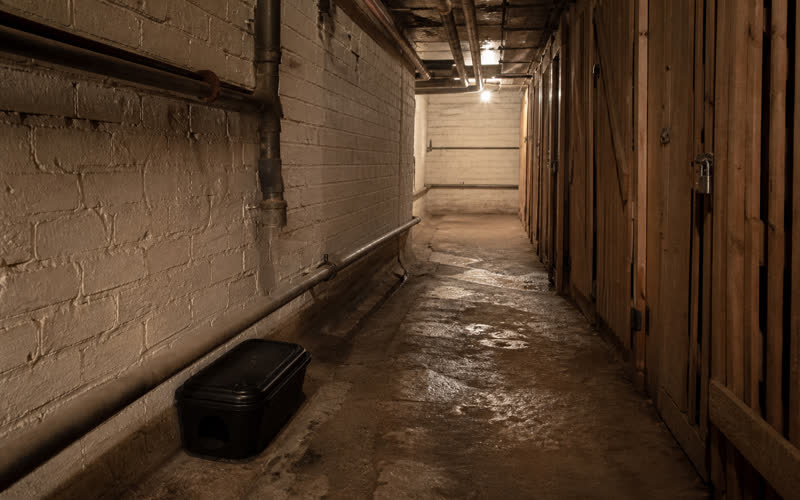
A basement combines everything they need: warmth from the heating substation, damp, darkness and pipe runs to travel along. The sewer is a direct route for the brown rat from the street mains into the building.
How to judge how serious the problem is
A few fresh droppings by a wall mean a visit. Droppings in several places, grease marks along the walls, gnawed cardboard packaging and a smell mean a nest — and that is a different scale of treatment.
What to do first
Do not sweep droppings up dry — the dust goes into the air. Use a damp cloth and gloves. Do not plug holes with expanding foam before the inspection: rats gnaw through it, and you lose the information about their runways.
When the problem is the whole building's problem
In an apartment block the basement is a communal space. If the rats are there, treating a single flat upstairs will give no result — the source is what has to be treated.
Inspecting a basement step by step
Start the inspection at the heating substation — it is warm and damp there, and there are almost always unsealed openings around the pipe entries. Work along the line where the wall meets the floor with a torch — rodents travel along vertical surfaces, not across the middle of a room. If there is a gap between a pipe and the concrete that your thumb fits into, that is enough for a rat to squeeze through. Open the inspection hatches and look into the sewer stack shaft — in older Riga buildings the cast iron joints are often loose, and that is exactly where an entry point forms. Then the storage cages, the ventilation openings and the outside door thresholds — if there is more than two centimetres between the bottom of the door and the floor, that is an open doorway. Photograph every find straight away — it will be easier later to compare whether movement is continuing.
How to tell a nest from a route through
A common mistake: someone finds a few droppings and concludes a colony is living in the basement, when in fact it is only a route through. A route through is marked by a long, linear band of tracks along a wall, individual droppings scattered evenly, and greasy dark rub marks on the wall render roughly five to ten centimetres above the floor. In a nest the droppings are concentrated in a small area — in a corner or under a shelf — and next to them is gnawed soft material: cardboard, mineral wool, fabric fibres, packed into a bowl shape. Added to that is a sharp ammonia smell, which a route through does not have. The practical significance is considerable: a route through means the source is outside your basement and the whole building has to be worked on, while a nest means breeding is taking place on the spot and action has to start immediately.
Why holes must not be sealed before treatment
Logic says: find the hole, concrete it up, problem solved. In practice this is precisely the action that drives rats into the flats. A basement colony forages along several routes. If you close all the lower exits in one day the animals do not disappear — they look for an alternative direction, and the only direction left is upwards, through the sewer and heating duct shafts. The result is that a few days later residents on the first and second floors start hearing scratching behind the kitchen wall. The correct order is the reverse: bait points are put in first and the population brought down, bait consumption is watched over two to three weeks, and only once consumption has stopped does the physical sealing take place. If you close up earlier, you wall the animals inside the building.
Clearing up droppings safely
Rodent droppings and urine contain pathogens that can get into the air along with dust. So never sweep dry in a basement and never use a vacuum cleaner — both send fine particles into the air in an enclosed, poorly ventilated space. The correct method is the wet one. Put on rubber or nitrile gloves and a respirator, and open the doors and windows for at least half an hour. Thoroughly dampen the contaminated area with a sprayer using soapy water or a bleach solution and let it stand for five to ten minutes. Pick the material up with paper towel, put it in a bag you can tie, and that bag into a second one. Wipe the surface down with a damp cloth. Wash the gloves before taking them off, then your hands.
What residents should store differently
Storage cages in an apartment block basement are the main reason rodents stay in a building after treatment. Cardboard boxes are not a storage container — they are ready-made nesting material, and so is old textile: blankets, outdoor clothing, offcuts of carpet, mattresses. Move anything you want to keep into rigid plastic boxes with lids. Store potatoes and onions in closed containers or on a metal mesh shelf, not in sacks on the floor. Do not leave sacks of animal feed in the basement at all. Leave at least thirty centimetres of clear floor along the walls so that inspection is possible and there are no hidden corridors to travel along. Tyres, furniture carcasses and building rubble that have stood in a corner for years have to go — nests are most often underneath them. It is worth agreeing this with the whole stairwell at once — one neglected cage sustains all the rest.
How to approach the building manager properly
The basement, the heating substation and the stairwell are communal spaces, and their upkeep is the responsibility of the building manager, not of an individual flat owner. The cost of treatment is therefore usually met from the building's maintenance funds. To make sure a request does not go unanswered, write it with concrete facts: date, room, exactly what you saw or heard, attach photographs and state how many flats are already affected. A vague sentence about something running about in the basement gets deferred; a request with photographs and five signatures usually does not. Ask the residents' representative to collect neighbours' signatures — a collective request changes the priority. If there is no answer within two weeks, submit the request again, asking for written reasons and a planned deadline for action.
Frequently asked questions
Who is responsible for rats in the basement?
In communal spaces — the building manager. The enquiry is usually submitted by the building manager or the residents' representative.
Can rats get from the basement into a flat?
Yes, through ventilation shafts and pipe runs.
How much does treating a basement cost?
It depends on the floor area; for commercial premises and communal spaces — from €70.
Can rats in a basement disappear on their own?
If the basement is warm and damp and nesting material is available, they do not disappear. A brief quiet spell usually means the animals have moved temporarily to another part of the building or a neighbouring one, and they return a few weeks later. Without bait points and a change in storage conditions the population only fluctuates rather than dying out.
How long does it take to see a result after a basement treatment?
The first changes are usually visible within five to seven days — the noises and the bait consumption both drop. Bringing the population down fully in a large apartment block basement takes two to four weeks, because bait acts with a delay and new animals join gradually. At least one follow-up check is needed during that time.
Are bait points in a basement dangerous to children and pets?
The product is placed in enclosed, fixed containers that can only be opened with a key, and they are positioned behind pipework, in corners and in service recesses where they are not freely accessible. The containers are labelled. Residents should not move or open them — if a container is found disturbed, the building manager should be told.
What smell indicates rodents rather than damp?
The smell of damp and mould is heavy, earthy and mushroomy, and even throughout the room. Rodent presence has a sharp ammonia note that gets stronger as you approach a particular corner or shelf and fades as you move away. If the smell is localised and sharp, inspect that exact spot — the nest is most often there.