
At a glance
- Service
- Rodent control in food businesses
- Area covered
- Riga and the surrounding region
- Price
- From €40 — the figure quoted is the final price
- Availability
- 24/7, weekends and nights included
- Reply time
- Within 5 minutes of the form being submitted
- How to book
- Through the enquiry form only
In the food chain, rodent control is not just a question of cleanliness — it is part of meeting hygiene requirements, and its absence is a direct risk to the running of the business.
The control point system
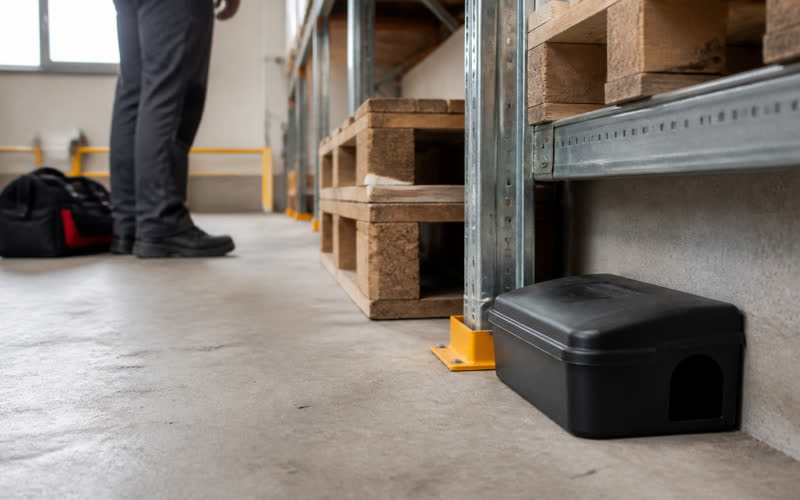
We set out numbered control points with a plan of their layout. Every check is recorded, so at any moment you can see where and when activity was found.
Bait in food zones
No bait is used in the food handling area itself. There we work with mechanical traps and monitoring points, and place the bait stations around the perimeter.
Documentation
We prepare a written record of the work carried out, the layout of the control points and a record of the activity found.
Non-toxic monitoring blocks and where they belong
On a food site a large share of the control points contain no active substance at all. Their job is different — to show whether there is movement in a particular place. A monitoring block is placed in a lockable station, and after a few days its surface clearly shows tooth marks if a rodent has been there. We use points like these anywhere there is open product, preparation surfaces, a packing line or finished-goods storage nearby — that is, wherever active products are not acceptable. The benefit is twofold: there is no risk whatsoever to the product, and at the same time a run of data builds up showing which rooms have movement and which do not. If the first marks appear at a monitoring point, that is an early signal that lets you act before you get damaged product or droppings on the packaging.
Separating raw materials, process and finished goods
The three zones in a food business have different risk profiles, and they cannot be serviced in the same way. The raw materials store is where deliveries bring the risk in — wooden pallets, cardboard, sacks of grain or flour. It needs a denser network of points along the wall lines and a firm rule to keep a 40 cm strip of floor clear along every wall. In the process zone we work only with mechanical traps and non-toxic monitoring points, placed along walls and in service recesses, never on or under work surfaces. In the finished-goods zone what matters is that everything is sealed and that product does not stand on the floor. The fourth ring — the outside perimeter and the waste area — is the only place where more active products are acceptable. The boundaries are marked on the site plan and observed on every visit.
Why the cleaning schedule matters more than the treatment frequency
Experience on food sites is unambiguous: what decides the outcome is cleanliness, not how often we come out. A business with thorough daily cleaning and quarterly servicing is usually cleaner than a business with monthly servicing and build-up under the machinery. The reason is simple — as long as there is food and water, the population recovers. The critical spots are the floor under and behind machinery, the joints at machine plinths, the area around gullies, spillage points where sacks are emptied, and where empty packaging is stored. In practice we recommend defining specific deep-cleaning positions at fixed intervals — under each machine once a week, behind the chillers once a month, say — and writing that schedule down. Only then does the work turn from fighting the consequences into monitoring.
Checking incoming goods
More often than not, a rodent does not come into a food site through a wall but with a delivery. A wooden pallet from a supplier's yard, a double-walled cardboard box, a shrink-wrapped block of sacks — any of them can hide a mouse or its droppings. It is worth building three checks into the goods-in routine: inspecting the underside and sides of pallets before they come into the store, checking the corners of packaging for gnawing with the characteristic 3–5 mm tooth grooves, and looking into the folds of the wrapping, where black droppings about the size of a grain of sand collect. If something is found, that unit must not go into the main store — it is separated off, photographed and a decision made about writing it off. We also recommend not keeping incoming cardboard for longer than necessary, since empty cardboard is nesting material in its own right.
What the work records should show
After every visit we prepare a written record of the work carried out, and its content is practical rather than formal. It gives the date and time of the visit, the rooms and zones inspected, the layout plan of the control points with their numbers, the condition of each point and the activity found, the structural defects found and where they are — gaps under doors, damaged seals, unscreened ventilation openings, sources of moisture — along with recommendations and the date of the next planned visit. We add photographs of the more significant findings. These records build a continuous history that lets you see the trend across several months and support internal decisions about repairs or changes to cleaning. The documentation describes the work done and the state of the site at the time of the inspection — it is not, and cannot be, any form of attestation or opinion.
How findings are escalated
Not every finding is equally urgent, so in practice we use a simple three-tier logic. Tier one — tooth marks have appeared at a monitoring point only, product is untouched. Action: increase the density of points in that zone, check the structure, note it in the report. Tier two — droppings or tracks in a room where raw materials or packaging are stored. Action: inform the person responsible for the site immediately, separate off the affected product, carry out an additional inspection within the next few days and step up monitoring. Tier three — damaged product, an animal seen or a nest in the process zone. Action: inform the same day, attend as soon as possible, shut down and clean the affected area, write off the product. In urgent cases we work around the clock. Fill in the form with the site profile and floor area — we reply within 5 minutes, and the price for commercial premises starts from €70.
Frequently asked questions
Do you prepare documentation for inspections?
Yes — a written record of the work carried out and the layout of the control points.
Do you use bait near food?
No. In food zones — mechanical traps and monitoring only.
Is regular servicing available?
Yes, and for food sites it is the recommended arrangement.
What is a non-toxic monitoring block?
It is a control element inside a lockable station that contains no active substance at all. Tooth marks are left on its surface if there has been movement in that spot. We use them anywhere there is open product or preparation surfaces nearby — they give an early signal with no risk whatsoever to the food.
What goes into the work records?
The date of the visit, the zones inspected, the layout plan of the control points with their numbers, the condition and activity at each point, the structural defects found and where they are, photographs and recommendations. It is a written record of the work carried out and of the state of the site, not any form of attestation.
What happens if damaged product is found during an inspection?
That is a top-tier finding. We inform the person responsible for the site the same day, the affected product is separated off and written off, the zone is cleaned, and shortly afterwards we carry out an additional inspection with a higher density of points in that room.