
At a glance
- Service
- Rodent control in a summer house
- Area covered
- Riga and the surrounding region
- Price
- From €40 — the figure quoted is the final price
- Availability
- 24/7, weekends and nights included
- Reply time
- Within 5 minutes of the form being submitted
- How to book
- Through the enquiry form only
An unoccupied building is ideal for rodents: no people, no noise, and often food or textiles left behind. In autumn and winter, a summer house becomes the warmest place around.
Pre-season inspection
Before the season we inspect the building, assess the damage and find the nests and entry points. That lets you start the season with no surprises.
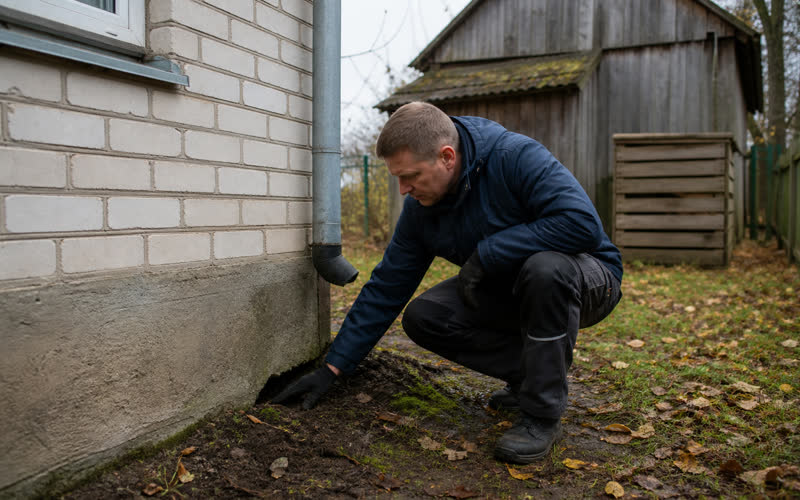
Protection before winter
Before you leave the building for the winter, preventive treatment and sealing entry points are worth doing — it costs less than putting right the consequences in spring.
Textiles and furniture
Mattresses, blankets and pillows are nesting material. If the building is to stand empty, it is best to store them in sealed containers.
Arriving in spring: what to do before you touch anything
When you open up a summer house after the winter, the commonest mistake is to pick up a broom and start sweeping straight away. Dry sweeping and vacuuming lift dust from dried droppings into the air, and that is exactly what you don't want to breathe in. The right order is different. First open all the windows and doors and let the rooms air for at least half an hour without staying inside. Only then go in, put on gloves and take a look round: the bottoms of cupboards, the edges of beds and mattresses, kitchen drawers, the basement stairs, the corners of the roof structure. Start the cleaning with the wet method — spray droppings and nesting material with soapy water, let them soak, and pick them up damp, putting them into a sealed bag. Then wash the surfaces down. This sequence takes half an hour longer, but it is considerably safer.
The autumn closing-up list
A summer house's fate over the winter is decided in September or October, when it is closed up. The practical list is short and specific. All food without exception has to go — including salt, sugar, flour, pasta, coffee, pet food and seeds. Anything that stays should be kept in metal or thick plastic containers with a hard lid, not in its original packaging. Mattresses and blankets should be stored higher up, ideally upright or in solid boxes, not on the bed. Bedding and towels should be taken away or put into sealed containers. Dishes should be washed and dried, and the sink wiped dry. Waste should be taken away, not left in a bin beside the house. The last step is to walk round the outside of the building and check the ventilation openings, the foundation vents, the pipe entries and the door thresholds.
Why food left behind is a guaranteed problem
There is no heat in an unheated house in winter, but if there is food, that is enough. Half a kilo of oats in a paper packet or half a sack of potatoes in the basement will keep a colony going all winter, and by spring it is no longer one mouse but several generations. How the food is stored matters just as much: paper, cardboard and thin plastic packaging is no obstacle and gets opened on the first night. Another source that is often forgotten is packets of garden seeds, bird food, dry dog or cat food in the shed, and vegetables for composting on a basement shelf. If the food cannot be taken away, the only real answer is a glass or metal container with a tight-fitting lid. This single step prevents more problems than any other piece of autumn preparation.
Water damage and rodents come together
In practice this repeats almost every spring: where there has been damp, there have also been rodents. A frozen and burst pipe, a blocked gutter, damaged roof covering above the veranda, or a foundation vent that let melting snow in — each of these produces not only water damage but also an opening and softened timber that a rodent can gnaw through easily. On top of that, wet insulation and rotted wood make good nesting material. So in a spring inspection we look at both things at once: where there are stains on ceilings or walls, we also check the insulation and the cavities in the structure. Fixing a water leak is part of rodent control, not a separate question.
Damage to mattresses, furniture and textiles
In a summer house the biggest losses are usually not food but soft furnishings. A mattress left on the bed is the best nesting spot in the whole building over winter: warm, dry, soft and dark underneath. The damage looks like a small hole in the fabric and a hollowed-out cavity in the filling, often together with droppings and a distinctive smell that does not go away with airing. Sofa covers, cushions, curtains, wool blankets and clothes in a wardrobe suffer in the same way. Practical advice: in autumn, stand mattresses upright and away from the wall, or wrap them in a thick plastic cover; keep textiles in solid, closing boxes; leave wardrobes open so the space airs and a nest doesn't go unnoticed. If a nest is found in a mattress, it usually cannot be cleaned and has to be thrown out.
Why rodents choose an unheated building
You often hear the assumption that rodents won't live in a cold, empty house. In practice the opposite is true. An unheated summer house is quiet, there are no people for months, no dog, no disturbance, and the structure — timber floor voids, the insulation layer, a raised floor, the roof build-up — offers places where the temperature is steadier than outside and where a nest of textile and insulation material provides its own warmth. In the summer-house villages around Riga, almost every house stands empty in winter, so there is no competition for these spots. On top of that, heating the place intermittently in spring produces exactly the pulse of warmth that encourages breeding. The conclusion is a practical one: protection does not depend on whether the house is heated, but on whether the entries are sealed and whether there is food and nesting material in the building.
Frequently asked questions
When is the better time to treat?
In autumn before the building is left, or in spring before the season.
Do I need to be there?
Preferably, so that we can look at the damaged areas together.
Do you cover summer houses outside Riga?
At present we work in Riga. Ask about the immediate surroundings via the form.
How do I clean a summer house safely if rodents have been in over the winter?
First air the rooms for at least half an hour without staying inside. Then work in gloves and use only the wet method: dampen the droppings and nesting material, let them soak and pick them up damp into a sealed bag. Don't sweep dry and don't use a vacuum cleaner. Wash the surfaces down and wash textiles in hot water.
There's a nest in the mattress. Can it be saved?
Usually not. If the filling has a gnawed-out cavity with droppings and urine in it, the mattress has to go — the smell and contamination in the deeper layer cannot be removed by cleaning. The bed frame and the surrounding surfaces need washing down. Next autumn, store mattresses upright or in a solid cover.
The summer house isn't heated in winter. Does that make the problem smaller?
No. An unheated building is attractive to rodents precisely because there are no people there for months, and the temperature in the structural cavities is steadier than outside. The decisive factors are sealed entries, food taken away and textiles put out of reach — not heating.