
At a glance
- Page topic
- Where rats and mice come into a house from
- Area covered
- Riga and the surrounding region
- Price
- From €40 — the figure quoted is the final price
- Availability
- 24/7, weekends and nights included
- What works
- Metal mesh with a 5 mm aperture and cement mortar; expanding foam does not
- How to book
- Enquiry form only — we reply within 5 minutes
The first question in every inspection is: how are they getting in? Without an answer to that, a treatment is only a reduction of the population.
Drains and pipework
The brown rat swims and travels through the sewer system. Unsealed pipe entries in the basement and open access hatches are a direct route into the building.
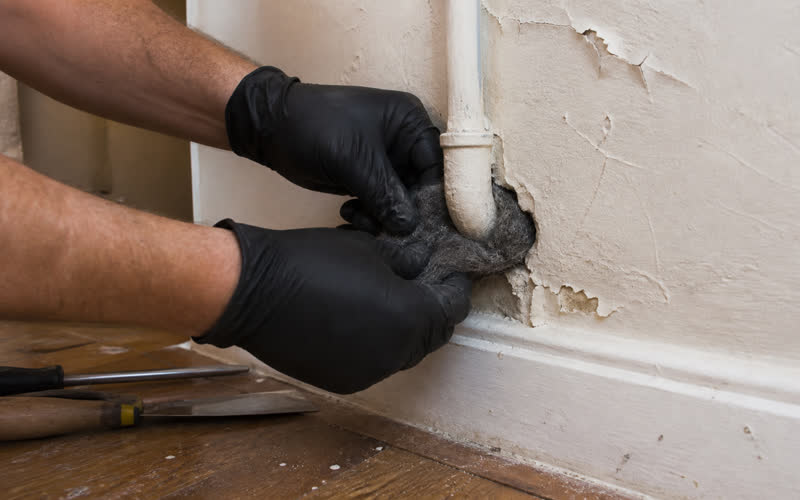
The ventilation system
A ventilation shaft connects every floor vertically. A damaged grille, or one with too large an aperture, lets rodents into any flat.
Foundations and façade
Gaps in the foundations, the bottom edge of a ventilated façade with no protective mesh, cracks and pipe entries. A rat widens an existing gap by gnawing away the material around it.
Doors, windows and routes from outside
Gaps under external doors and garage doors, damaged basement windows, heating mains and tree branches touching the roof. A threshold with a 15 mm gap is an open door to a mouse.
Tracing the route backwards
The most practical method starts not with walking round the building but with the place where the signs were found. If there are droppings under the sink, the question is not where the hole in the house is, but how the animal got into that particular cupboard. Follow the line where the wall meets the floor — rodents travel along vertical surfaces, not across the middle of a room, and the band of tracks leads to the source. Dark grease marks on the plaster five to ten centimetres up show a regularly used route. Follow that line to the point where it disappears — usually a pipe entry, a ventilation opening, a gap in the floor or the base of a partition. Compare how fresh the droppings are in different places: where they are darker and softer, the movement is more recent. This logic shortens the search considerably.
Why animals follow pipes and cables
Pipework and cable runs in a building are continuous, pass through every floor and cross every wall, and that is exactly why they become the main route. At every point where a pipe enters a wall or a slab, a gap is left during construction, and that gap is rarely filled completely. Heating mains and hot water pipes add another reason — warmth, which attracts in winter, and the air in a shaft alongside them is warmer than in the rooms around it. Electrical cable ducts are narrow, enclosed and safe from predators, so they get used as a protected corridor. The practical conclusion is clear: if activity appears on several floors or in several flats at once, look for the vertical shaft rather than a separate hole in each room. The route is always shorter along a run that already exists.
Building work and demolition nearby
One of the commonest reasons a problem appears in a building where there has been nothing for years lies outside it. When excavation starts in the block, a sewer run is opened, an old building is demolished or a basement is cleared out, the population living there loses its shelter in a single day and moves to the nearest occupied buildings. Prolonged road or utility works in the street do the same. The pattern is characteristic: activity appears suddenly, in several buildings along one stretch of street at once, and affects basements and ground floors first. If you know there is building work nearby, acting in advance makes more sense than waiting — check the foundation line, the service entries and the gaps under doors beforehand, not after somebody already hears noises.
The bin area as a neighbourhood source
Often the answer to the question of where they come from is not in the building at all, but twenty metres away. A bin area with permanently half-open containers, bags left beside them and a pile of cardboard feeds the whole block, and the buildings around it become no more than sleeping quarters. In Riga courtyards this pattern is typical — several buildings use one bin area, and none of them regards it as their responsibility. The signs are easy to check: burrows dug into the ground or under the edge of the asphalt by the containers, gnawed bags, droppings by the wall of the enclosure. The solution is usually not technical but organisational: closable containers, a hard base with no gaps to the soil, bags inside the container rather than beside it, and a collection frequency that matches the volume. As long as the feeding place exists, treating individual buildings gives only a short-lived result.
How a route inspection is carried out in practice
The inspection is systematic and starts outside. First the building is walked round the perimeter, looking at the foundation line, the plinth, the ventilation openings, the basement windows, the bottoms of doors and the points where water, drainage and electrical services enter the wall. The surroundings are assessed too — the bin area, the log pile, the compost, neighbouring structures. The inspection then moves inside and works from the bottom up: basement and heating substation, stairwell, pipe shafts, plant rooms, then the living or working areas and finally the attic. In each space three signs are recorded — droppings, grease marks and gnawing with fresh edges. The finds are photographed and tied to a specific location, and from them a map is built up showing where the way in is, where the route runs and where the feeding place is.
What changes after renovation
Renovation changes a site in two ways. On the one hand it can close the old routes. On the other, it is during renovation that new ones appear: holes drilled through walls for ventilation and air conditioning, water and drainage pipes moved with new entries, floors taken up with gaps left open, doors and windows standing open for long periods, building rubble and packaging in the yard. If mineral wool or polystyrene goes into the partitions, it becomes ready-made nesting material somewhere nobody can see it. Almost always expanding foam is used as the only filling at the service entries, and it is gnawed through within a few weeks. So after any substantial renovation it is worth walking the site again and checking every place where a wall or slab was opened up — the old route survey no longer matches reality.
Frequently asked questions
Can rodents get into a new house?
Yes, if pipe entries or façade gaps are left unsealed.
How do you establish the exact route?
By the grease marks, droppings and gnawing at the point of entry.
Should all the gaps be sealed straight away?
Treatment first, then sealing.
How do I tell whether rodents are coming from outside or already living in the building?
By how the signs are distributed. If the droppings are strung out in a linear band along a wall and evenly scattered, that is a transit route and the source is outside. If they are concentrated in a small area together with shredded soft material and a sharp smell, breeding is going on in the building.
Can rodents reach the upper floors?
They can, and it is not unusual. They travel through drainage and heating shafts, ventilation ducts and cable runs that pass through every floor. Movement up façade downpipes and along tree branches onto the roof is possible too, where they reach the building.
What should I do first if building work has started nearby?
Check the building's foundation line, the pipe entries, the basement windows and the gaps under the external doors, and sort out the bin area. If the first signs appear, fill in the form and mention that there is building work nearby — it changes the priorities of the inspection and lets us start from the perimeter.