
At a glance
- Location
- Centrs
- Service
- Rodent control — rat and mouse extermination
- Price
- From €40 — the figure quoted is the final price
- Availability
- 24/7, weekends and nights included
- Getting there
- We travel from Riga; arrival time agreed per address
- How to book
- Enquiry form only — we reply within 5 minutes
Rodent control in Centrs: commercial density as the deciding factor
Centrs is Riga's main administrative, commercial and cultural area, and it is commercial density that shapes what rodent control looks like here. Restaurants, cafés, shops, hotels and offices work side by side in a single block, and they all produce food waste on the same daily rhythm. In practice that means something simple: if the waste area or the back of the kitchen in one building is left untreated, it feeds the whole surrounding block, and the result will not hold at the neighbouring premises. So rodent control in Centrs is almost never a single address — the inspection starts with the question of where the nearest permanent food source in this block is. The brown rat moves within a radius of a few dozen metres around it, and in Centrs that radius usually covers several buildings. Practically, the boundary of a property on paper and the rodents' feeding territory do not coincide, and we build the plan around the second, not the first.
Restaurants and cafés: work outside opening hours
Rodent control in a restaurant in Centrs is almost always planned outside trading hours — in the morning before opening or at night after closing. The reason is practical: the inspection requires opening up the bases of kitchen equipment, checking the inlets of extraction ducts and looking behind refrigerators, and none of that is possible during a working shift. It is also in the client's interest — guests must not see bait stations in the dining room. Control points go in the service rooms, along the store-room perimeter and by the goods-in door, not in the customer area. At every check we record which points show activity and what structural faults were observed; a written record of the work carried out stays on site. For commercial premises prices start from €70, depending on floor area, the number of rooms and the frequency of checks. The initial inspection shows how many points the site actually needs.
Shared courtyards and communal bins
Dense building means that most buildings in Centrs have an enclosed inner courtyard where the bins are used by several businesses and flat owners at the same time. A waste area in a courtyard like that is the whole problem concentrated in one spot: overfilled bins, sacks beside them and stacks of cardboard against the wall. We place bait stations along the courtyard perimeter and by the basement windows, but without sorting out how the bins are managed the effect is short-lived. Access to the courtyard is an organisational problem too — the gates are often locked and the key is with the building manager, so we arrange the inspection with them in advance. If a building has both flats and commercial units, in practice you always have to work with both parts, otherwise the rodents simply move between floors. We therefore inspect the courtyard at the same time as the basement, not on a separate visit.
Pre-war masonry buildings: deep basements and old pipe outlets
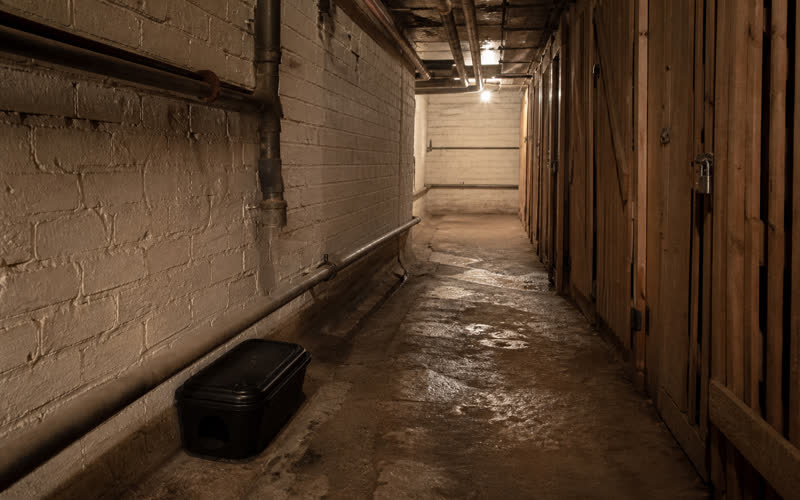
The Art Nouveau and pre-war masonry buildings in Centrs were built with deep, branching basements that often still hold old fuel stores and rooms no longer in use. In a basement like that the brown rat finds exactly what it needs: darkness, warmth and quiet. The original drainage outlets matter just as much — over the decades they have crumbled at the connection points, and the sewer stack becomes a permanent route upwards. During the inspection we work along the basement walls looking for grease marks 5–10 cm above the floor — they show the route more precisely than isolated finds do. A rat burrow entrance at the edge of the foundations is 5–8 cm across; if it is in the courtyard, indoor work alone is not enough. In cases like that we place control points both in the basement and between the burrow and the entrance to the building.
Access, transport and how the work is organised
Centrs has dense public transport and busy main streets, but vehicle access is often restricted and finding a parking space on the Vecrīga side or near the station is hard. That affects how the work is organised more than you might think: equipment has to be carried by hand, and at sites with several wings a single inspection takes longer. So we agree a specific arrival window and find out in advance where a vehicle can stop to unload. We work 24/7, including emergency callouts when rodents have appeared in a hotel or café in the middle of the working day. Fill in the form with the address, the floor and the access arrangements — we reply within 5 minutes and can immediately plan a time that suits the site. The more precisely access is described, the less time is lost searching on arrival and the sooner the inspection itself begins.
Flats above commercial units and sealing entry points
Rodent control in a flat in Centrs most often starts with the same situation: a café or shop below, residential floors above, and the noise starts to be heard in a partition wall or by the ventilation shaft. The house mouse squeezes through a 6–7 mm gap and the brown rat needs only 20 mm, so holes around pipework filled with expanding foam achieve nothing — they are gnawed through in a few nights. We seal entry points with metal mesh of 5 mm aperture combined with cement mortar. Mouse extermination in a single flat without that step only reduces the numbers. Treating a flat costs €40–80, and the minimum callout charge is €40. If the problem is coming from the commercial floor below, we recommend informing the building manager as well, since the ventilation shaft and the stack are shared by the whole stairwell.
What rodent control in Centrs includes
Rodent control in Centrs means a full cycle, not a single treatment. Rat extermination and mouse extermination start with an inspection: we identify the species, find the runs and the entry points, and only then choose the method. Rodent control includes placing tamper-resistant bait stations or mechanical traps on the actual runs, a follow-up check and specific advice on what needs sealing so the problem does not come back. The price depends on the type and size of the property: treatment starts at €40, and the figure quoted is the final price. Describe the property in the form — we reply within 5 minutes.
Frequently asked questions
Can you work at night, when the restaurant is closed?
Yes. In Centrs that is the usual way we work — we operate 24/7, and at most catering premises the inspection and the servicing of bait stations happen before opening or after closing. That way it is possible to open up the bases of equipment and check the service rooms without disturbing guests. We agree the exact time in advance, and it can be a repeating regular window at every service visit.
There is a restaurant in the neighbouring building. Can anything be achieved in our house at all?
It can, but how long the result holds will depend on that source. In dense building rodents move between buildings through the courtyard and the drains, so we close the entries into your building and place control points around the courtyard perimeter at the same time. If possible, it is worth talking to the building manager about the shared waste area — without that the result will need maintaining for longer.
How do you get into the courtyard if the gates are locked?
We arrange access in advance — usually through the building manager or the person responsible for the site, who opens the gates at the agreed time. In Centrs that is a standard step, because without inspecting the courtyard and the basement you cannot see where the rodents are coming from. Please give us this information in the enquiry form, so the technician is not left waiting at the gate.
How long does it take before the bait stations start working?
The brown rat is wary of anything new, so for the first 3–7 days it may not go near the stations. That is not a sign of failure but normal behaviour. During this time the important thing is not to move the stations and to limit the food available in the waste area, otherwise the bait stays less attractive than the kitchen waste. The house mouse does not show this caution and reaches the points sooner.