
At a glance
- Topic
- A dead rat in the wall — how long does the smell last
- Signs
- Droppings, grease marks, gnawing, noise
- Mouse gap
- From 6–7 mm
- Rat gap
- From 20 mm
- What fixes it
- Inspection, bait stations or traps, sealing entry points
- How to book
- Enquiry form only — we reply within 5 minutes
This is one of the commonest consequences of using poison yourself: the rodent dies inside the structure, where it cannot be reached.
How long it goes on
For a mouse — usually 1–2 weeks; for a rat — 2–4 weeks. In a warm room the process runs faster and the smell is stronger; in a cool one it takes longer but is weaker. Ventilation shortens the period considerably.
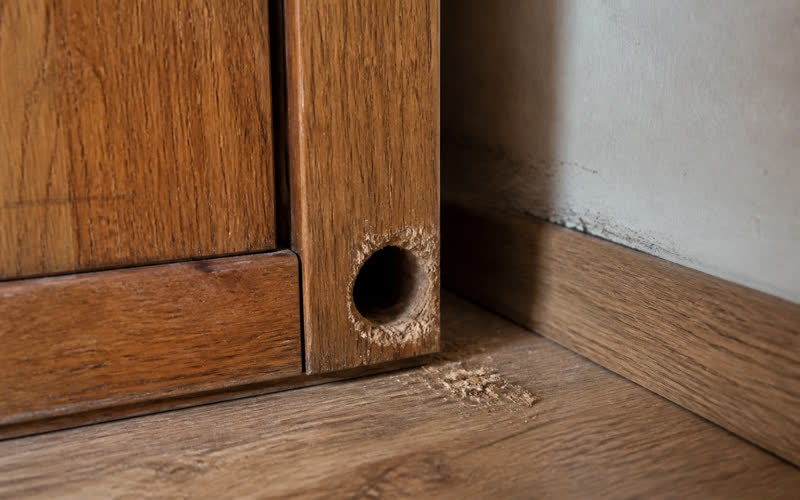
How to find the spot
The smell is strongest right at the source. Check whether flies appear anywhere — that is a reliable indicator. The source is often by an external wall, a ventilation shaft or under the floor.
What you can do
Increase the ventilation and use activated carbon absorbers. Aerosols only mask the smell. If the spot is precisely known and accessible, the animal has to be removed and the surface disinfected.
How to avoid it altogether
It is for exactly this reason that in places where a rodent could die inside an inaccessible structure we use mechanical traps rather than bait. A trap lets the animal be removed.
The intensity of the smell week by week — what to expect
Knowing the curve to expect is useful, because it answers the main question: wait it out or act. For the first two or three days the smell is usually faint and easily mistaken for damp or drains. From around the fourth day it sharpens rapidly and peaks at the end of the first week — at this stage it is at its worst, sweet and cloying, and noticeable in adjoining rooms too. In the second week the intensity stays high but no longer increases. From the third week it gradually fades, becomes drier and starts to resemble the smell of dust. For a medium-sized animal in a warm room the whole process takes roughly three to six weeks; longer for a larger animal and in cooler conditions. If the smell has not diminished after eight weeks, the cause is most likely something else and the place needs inspecting again.
The effect of temperature and air exchange
Two factors determine almost everything. Temperature: in a warm wall next to a heating riser or above a radiator the process runs faster and the smell is heavier, but it ends sooner; in a cold external wall or an unheated basement it can stretch over several months with a weaker but very persistent smell. The practical conclusion: if you can find the spot, turn the heating down in that particular room for a while — it does not remove the smell, but it makes it more bearable. The second factor is air exchange. In a closed room the smell builds up and soaks into textiles, wallpaper and furniture, so creating a through draught is the most important daily step: open a window in the room and another on the opposite side of the house so that a flow develops. A fan blowing towards an open window speeds up the exchange. Do not cover the shaft grilles.
Activated carbon and other safe aids
Of the freely available remedies, activated carbon works best. It is sold as granules or in sachets and should be placed close to the source of the smell — by the skirting board, next to a ventilation grille, at the back of a cupboard. You need a sufficient quantity and an open surface: several shallow trays of granules work better than one deep one. The carbon needs changing roughly every two weeks, as it becomes saturated. In addition you can put out open dishes of baking soda or silica-based cat litter — they absorb moisture and some of the smell. Wash the textiles, curtains and bedding from the affected room, since they hold the smell even after the source has gone. Do not use ozone generators in rooms where people and pets are present — ozone is an irritant, and using it requires the room to be emptied completely and aired for a long time.
Why aerosol air fresheners make things worse
An aerosol freshener removes nothing — it adds a strong synthetic scent on top of the existing smell. The result is a combination that most people tolerate worse than the original smell, and it also lasts longer, because the carriers of the fragrance settle on textiles and walls. The second problem is practical: once a room has been sprayed you can no longer judge whether the smell is fading or growing, and that trend is the only indicator of how the process is going. The third is that a freshener also masks the differences in the direction of the smell, which you need in order to find the source. Use a through draught, activated carbon and washing surfaces down with detergent instead. If people with respiratory sensitivity are in the room and complaints arise, that is a question for a doctor, not for an aerosol.
Damp stains and pinpointing the exact cavity
Before thinking about opening a wall, the spot has to be located as precisely as possible. The first sign is a damp or discoloured patch: on plasterboard, wallpaper or ceiling paint a small yellow-brown or grey area appears, usually a few centimetres across, with an irregular edge. It sits directly below the spot or slightly lower, because moisture runs downwards. The second method is systematic sniffing: work along the wall with your nose 10–15 cm away, stopping every 20 cm, and mark the places where the smell is strongest with masking tape. The third — check every opening: sockets, switch boxes, pipe entries, gaps at the skirting. Air comes out of these boxes straight from the cavity, so the smell there is the most informative. If all three methods point to one and the same spot, that is most likely the right one.
When opening a wall is justified and how it is done
Opening up is justified in three cases: the smell is unbearable and the room has to be lived in, the spot has been precisely located by several methods, and the structure is such that access is possible with minor damage — a plasterboard partition, a fitted unit, a pipe-shaft panel or a suspended ceiling. In practice you first try access without cutting: remove the shaft inspection hatch, the bath panel, a skirting board or a socket box. If that does not help, cut a hole of about 10 × 10 cm in the plasterboard at the marked spot, keeping the cut-out piece to close it up again afterwards. Once the animal has been removed, wash the cavity with soapy water, dry it, put the piece back on a timber batten, fill and repaint. Brick and concrete walls are not opened — there you look through the adjoining shaft or the ceiling. Fill in the form and we reply within 5 minutes.
What to do in a rented flat
In a rented flat the order of action differs, and it is worth following. First, inform the landlord or building manager in writing — by email or text message, so that the date is on record. Include a specific description: when the smell started, in which room and which part of the wall it is strongest, whether a damp patch is visible, and what you have already done. Photograph the patch with something for scale. Do not start cutting into walls, suspended ceilings or shaft panels yourself — opening up the structure without agreement can leave you liable for the damage, and in a block of flats the shafts are common property. While the matter is being dealt with, do what is in your hands: through draught, activated carbon, washing textiles. If the smell comes from a communal area or the stairwell, the report goes to the building manager rather than the flat's owner.
Frequently asked questions
Does the wall have to be opened?
In most cases no — the smell passes on its own. Opening up is a last resort.
Is the smell harmful?
Unpleasant, but not dangerous over a short period. The hygiene risk is at the spot itself.
How do I prevent it in future?
By not using bait in places where the animal cannot be reached.
How many weeks does the smell build before it starts to fade?
It is faint for the first two or three days, peaks at the end of the first week and stays high through the second week. From the third week it gradually fades. In a warm room the whole process takes roughly three to six weeks; in a cold external wall or a basement, considerably longer.
How do I pinpoint which wall cavity it is in?
Use three methods together: look for a yellow-brown damp patch, which is usually directly below the spot; work along the wall with your nose 10–15 cm away, stopping every 20 cm; and check sockets, switch boxes and pipe entries, where the air comes straight out of the cavity.
What should I do if the flat is rented?
Inform the landlord or building manager in writing, giving the start date, the room and the place where the smell is strongest, and attach photos. Do not open up any structure yourself, since in a block of flats the shafts are common property. While the matter is being resolved, create a through draught and use activated carbon.