
At a glance
- Topic
- Mice under the floor and in partition walls
- Signs
- Droppings, grease marks, gnawing, noise
- Mouse gap
- From 6–7 mm
- Rat gap
- From 20 mm
- What fixes it
- Inspection, bait stations or traps, sealing entry points
- How to book
- Enquiry form only — we reply within 5 minutes
The voids under a timber floor, partition walls and the insulation layer are warm, quiet and completely safe places for a nest. That is exactly why rodents choose them.
Why traps in the room do not work
If rodents live inside the structure and only come out for a few minutes, a trap set in the middle of the room stays untouched. Traps have to go right at the exit points — at gaps in the skirting, pipe runs and stair treads.
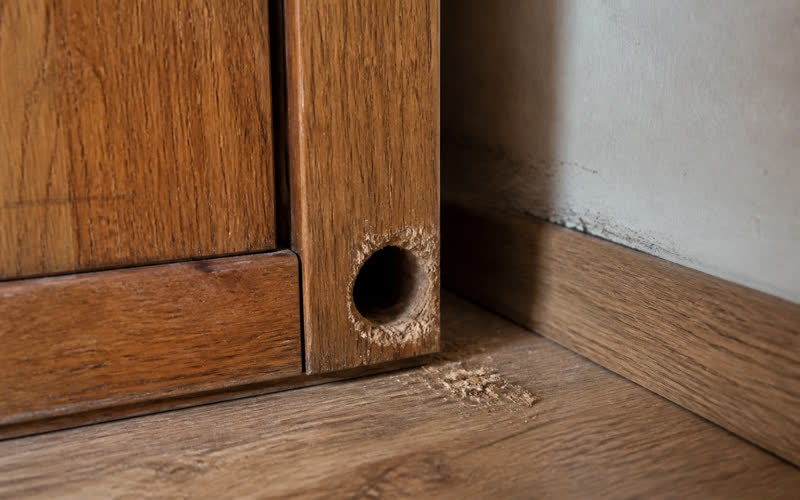
How to find the exit points
Look for fresh droppings, greasy marks along the skirting and round holes gnawed in timber surfaces. The night-time noise is usually strongest where the nest is.
Does the floor have to be opened up?
In most cases no. If the exit points have been located precisely, the treatment works without opening the structure. Opening up is only needed if the nest is extensive and there is no other access.
Why the problem comes back
Voids in a structure usually connect to the outer wall or the basement. If that connection stays open, the voids will be occupied again.
How timber floors are built in older Riga houses
In pre-war and inter-war houses the floor is usually not solid. Battens sit on the load-bearing joists and boarding sits on the battens, but between the joists is a void ten to twenty centimetres deep, filled at the time with sand, clinker, straw, wood shavings or sawdust. Over the decades this fill settles, and a continuous, warm, dry and completely dark corridor forms under the floor, running the whole length of the room and often under the partition into the next one. A mouse has everything it needs there: warmth from below, nesting material on the spot and protection from any predator. That is why in blocks of flats with timber floor structures the problem is systemic — the animals move around the whole floor of the building, not one flat, and the work has to be planned by group of premises rather than by single room.
Why sound misleads you about the location
A timber structure conducts sound along the length of the joists, and the boarding acts as a resonator, so a noise that seems to come from the bed side may in fact originate three metres away by the outer wall. The practical technique is deliberate listening at several points. After midnight, when the house is quiet, put your ear to the skirting at several places in turn and note each time where the sound is sharper and where you can hear distinct gnawing or scratching rather than a hollow rumble. The second guide is the heat and moisture lines: mice move along the heating pipes and the base of the outer wall, so start the inspection there. The third is that places where the sound recurs at the same time several nights running are closer to the nest than random noises.
A torch and a mirror at the skirting gaps
Most entry points are not visible when you are standing up — they are at the bottom edge of the skirting, behind a radiator, under the plinth of fitted kitchen units or at a pipe entry. The practical tools are a bright pocket torch and a small mirror on a handle, of the sort used in a garage or by a dentist. Hold the torch low and direct the light along the plane of the floor rather than downwards — that way every gap casts a shadow and becomes visible. Use the mirror to look under plinths and behind radiators. Look for three signs: a round or oval opening from about six millimetres, which is already enough for a mouse; a dark greasy smear around the edges; and small, rice-grain-shaped droppings. Mark each find with tape on the skirting and photograph it — you will need to compare after treatment.
The flour dust method for confirming exits
This is the simplest and most reliable check you can do at home. In the evening, sprinkle a thin, almost transparent layer of ordinary wheat flour, starch or talc over the suspect places — a band about fifteen centimetres wide along the skirting at each possible opening. The layer must be thin enough that the animal does not get stuck in it and change its route. In the morning, look at it at an angle against the light: mouse tracks are tiny, with a visible tail-drag line down the middle, and they always run along the wall rather than across the middle of the room. If there are tracks at only one of five points, you have found the real exit and can rule the others out. Repeat the test for two nights to exclude coincidence, and again after treatment — a clean layer three nights running is the best sign that the movement has stopped.
Why gaps must not be sealed before treatment
Instinct says to close everything up at once, but the order is decisive. If you silicone or foam up the gaps in the skirting while there are still live animals in the structure, you shut them in. There are two consequences. First, the mice look for another way out and start gnawing in a new place — usually the softest one, that is, around electrical cable entries or under kitchen units. Second, animals left in a sealed void without water die there, and for two weeks the flat has a heavy, sweetish smell that cannot be got rid of without opening the structure. The right order is: bait points and traps right at the exits first, then two to three weeks of monitoring with the flour test, and only once movement has stopped, physical sealing with steel wool and mortar.
Damaged insulation as a hidden cost
The losses under floors and in partitions rarely stop at noise. Mice drag mineral wool, cellulose insulation and pieces of polystyrene away to build nests, compress it into heaps and contaminate it with urine and droppings — contaminated material loses its shape, holds moisture and stops working as insulation. The result is felt as a cold floor by the outer wall in winter and localised condensation on the skirting. The second and more dangerous kind of damage is the electrics: in timber floor structures the wiring often runs straight through the void, and gnawed insulation creates a short-circuit risk. The third is chewed-up lagging on heating pipes. So if the floor is opened up anyway for repairs, it pays to replace the contaminated insulation, check the wiring and only then lay the new boarding, all in one go.
Frequently asked questions
Can a rodent die inside the structure?
That risk exists. It is exactly why we often choose mechanical traps in such places.
How long will the noise go on?
As long as the population is active. After treatment it usually stops within a few days.
Does the floor have to be taken up?
In most cases no.
How small is too small a gap for a mouse?
In practice, assume an adult house mouse gets through a round opening of about six millimetres and through any narrow slot that will take a pencil. So when sealing, do not go by what looks big, but by everything wider than a pencil, including holes around cables and pipe entries.
Can mice come in from a neighbour's flat through a partition?
Yes, and in houses with timber floor structures that is a normal route. The void in a partition frame often connects two flats, or a flat and the stairwell. If the neighbours have the same noises, treatment has to be planned on both sides at the same time, otherwise the animals just move back and forth and the result is short-lived in both places.
Do ultrasonic repellers help under a floor?
Devices like these are not worth relying on. The sound does not pass through the boarding and the fill, so it never reaches the structure at all, and even in an open room the animals get used to it within a few days. What produces results is removing food sources, bait points at the exits and sealing the structure after treatment.