
At a glance
- Page topic
- House mouse
- Mouse droppings
- 3–6 mm
- Rat droppings
- 15–20 mm
- Grease marks
- Rat 5–10 cm, mouse 2–5 cm above the floor
- Burrow entrance
- 5–8 cm
- Treatment
- Book through the form — we reply within 5 minutes
The house mouse is small, inquisitive and extraordinarily adaptable. Those qualities are exactly why it is the rodent you meet most often indoors.
How to recognise it
Body 7–10 cm, tail about the same length, large ears, pointed snout, greyish-brown coat. Weight only 15–25 g. Droppings 3–6 mm.
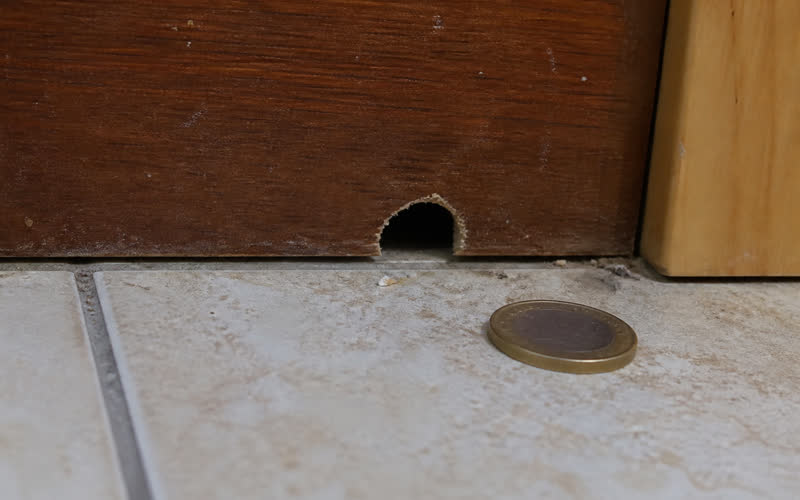
Why gaps are decisive
A mouse passes through an opening no wider than a pencil — around 6–7 mm. That means almost every building has places it can get in, unless those places have been sealed deliberately.
How fast they breed
One female can produce 5–10 litters a year with 4–8 young in each, and the offspring are sexually mature at six weeks. A few weeks of waiting therefore changes the size of the population substantially.
Behaviour that helps the treatment
Unlike rats, mice are curious and investigate new objects. Correctly placed traps often work on the very first night. Mice also rarely travel more than 3–10 m from the nest — which helps pin down exactly where they are.
Skeleton: why a 6–7 mm gap is enough
The house mouse (Mus musculus) physically cannot get through a hole smaller than its skull — but the skull is the only rigid part. A mouse has no collarbone holding the shoulder girdle at a fixed width, as in humans and larger mammals, and its rib cage is flexible. So an adult mouse weighing 18–20 g squeezes through a gap roughly 6–7 mm wide — less than the diameter of an ordinary pencil. The practical test during an inspection is exactly that: if a pencil goes into the gap, so will a mouse. In a flat, the decisive places are the ones the eye reads as closed — pipe entries under the sink, the edges of ventilation grilles, door bottoms with an 8 mm gap to the threshold, splits between the skirting board and the wall. For sealing, use galvanised fine-aperture mesh and mortar; expanding foam and silicone are, to a mouse, simply soft material to chew through.
Climbing and jumping: height is not protection
A house mouse does not move around a building in two dimensions, and forgetting that is one of the commonest mistakes in planning a treatment. A mouse climbs rough vertical surfaces — brickwork, render, concrete walls, wooden posts — because its claws catch on the slightest relief. It travels along cables and pipework, balances on a narrow edge and jumps about 25 cm straight up from standing. Falling a metre leaves it unhurt and still running. Several practical points follow. Food in the upper kitchen cupboards is not safe — the back of the cupboard, with its gap at the wall, is as accessible as the floor. Traps and stations must not go only on the floor: if there are tracks and droppings on a shelf or the top of a cupboard, that is where a control point is needed. In lofts and dropped ceilings, mice often live entirely independently of the floor level of the flat.
The feeding pattern: many small mouthfuls in many places
A rat comes, eats and leaves. The house mouse feeds quite differently: in one night it visits 20–30 different spots and takes only a few dozen milligrams at each. Total daily intake for an adult mouse is about 3 g of dry food — a tiny amount, broken up into many minute feeds. This pattern dictates the tactics directly. One large bait station in the corner of a room does not solve a mouse problem, because it simply is not part of the animal's route. What is needed is a dense network of points — many small control points every 2–3 metres along walls, behind appliances, at the backs of cupboards and in service ducts. For the same reason, mice always take part of the bait offered in several places rather than emptying one. It also explains why food left out in the kitchen spoils the result: if there is an alternative in every cupboard, the control point is competing with twenty others.
Independence from water: why removing water sources does not help
A common piece of advice is to cut off the mice's water — dry the sinks, fix the dripping tap, empty the pet bowls. Against the house mouse this barely works. A mouse's kidneys concentrate urine very efficiently, and the animal gets most of the moisture it needs from the food itself. On cereals, flour, dry pet food or food scraps a mouse manages for weeks with no free water; if the food is wetter — fruit, vegetables, cooked meals — the question does not arise at all. With rats it is different: they seek water deliberately, and that difference is where the wrong advice comes from. The practical conclusion on site is that limiting moisture is not a mouse-control tool. Results come from reducing the availability of food — airtight containers for cereals, clean work surfaces, waste in a closed bin — together with sealing entry points and a dense network of control points.
The nest: what mice build it from in a Latvian home
A mouse nest is a ball roughly 10–12 cm across, made of finely shredded material, and it is almost always within 3–5 metres of a food source. In Latvian flats and houses the material used is very predictable: mineral wool and other insulation layers, corrugated card, sheets of paper, textiles from rarely opened clothes boxes, furniture upholstery, pillow filling, cable insulation. In lofts, where the insulation is loose, nests are hard to spot, but the material turns out to be packed into tunnels. There are two practical consequences. First, when inspecting a property you look for exactly these points — a split in the insulation, a pulled-apart pile of cardboard in the corner of a store room, packed textile at the bottom of a wardrobe; finding the nest shows the centre of the population far more precisely than scattered droppings do. Second, control points go between the nest and the food, not somewhere in the middle of the room — all the activity happens along that short route.
One mouse is never one: how the real number is judged
Seeing a mouse during the day means the infestation is already fairly heavy — a normally active animal moves at dusk and at night. The real scale is judged from the distribution of droppings, not from the animals you see. Mouse droppings are 3–6 mm long, dark, with pointed ends, and a single mouse leaves 50–80 a day. If the pellets are in one place only — under the sink, say — you are usually dealing with one or two mice. If they are in several rooms some distance apart, at different levels and on shelves, the population is at least a few dozen. Freshness and colour add to the picture: shiny, soft pellets mean activity within the last few hours, dry and grey ones are old traces. You also look at gnawing on packaging, fine shavings along the skirting boards and the characteristic ammonia smell, which appears only where numbers are high. If you think there is one mouse in the house, fill in the form — an inspection shows how wide the zone of activity really is.
Curiosity versus caution: why traps work on mice straight away
Operationally, the main difference between a mouse and a rat is the attitude to a new object. A rat is neophobic and may walk around a new bait station for a week. The house mouse is markedly curious: it investigates a change in its territory on the first night, and a correctly placed trap works immediately. That changes how the work is planned — with a mouse problem, the first night's result is real information rather than luck. If the traps are untouched, the mistake is most likely the placement, not the animals' caution. Mice travel along walls and the edges of objects, so a trap in the middle of a room will stay empty even where numbers are high. The second practical conclusion: because a mouse's range is small, every trap that fires marks an active point around which several more should be placed. In Riga we work around the clock and go out on emergency callouts at weekends too; we reply to a form submission within 5 minutes.
Frequently asked questions
How far does a mouse travel from the nest?
Usually 3–10 m — which is why traps must go close to where the signs are.
Does one mouse mean a problem?
It is almost never on its own.
How fast do they breed?
Very fast — the offspring are sexually mature in six weeks.
How wide a gap has to be closed to keep a mouse out?
Everything wider than about 6–7 mm. A mouse has no collarbone and a flexible rib cage, so an adult squeezes through a 6–7 mm gap. The simplest check is a pencil: if it goes in, so will a mouse. For sealing, use galvanised fine mesh and mortar — expanding foam a mouse chews straight through.
Can mice climb into upper cupboards and onto shelves?
Yes. The house mouse climbs rough vertical surfaces, travels along cables and pipes and jumps about 25 cm from standing. A fall of a metre leaves it unhurt. Height therefore does not protect food, and control points must go on shelves and cupboard tops too if there are tracks or droppings up there.
Will mice leave if every water source in the house is cut off?
No. A mouse's kidneys conserve moisture very efficiently, and the animal gets most of its water from the food itself. On cereals or dry pet food a mouse manages without free water. Results come from restricting food in airtight containers, sealing entry points and a dense network of control points.
How do you tell how many mice are in a flat?
By the distribution of the droppings. Mouse pellets are 3–6 mm long with pointed ends, and one mouse leaves several dozen a day. If they are in one place only, it is one or two mice; if they are in several rooms, at different levels and on shelves, it is several dozen. Shiny pellets point to activity within the last few hours.