
At a glance
- Topic
- Mice in a flat — what to do
- Signs
- Droppings, grease marks, gnawing, noise
- Mouse gap
- From 6–7 mm
- Rat gap
- From 20 mm
- What fixes it
- Inspection, bait stations or traps, sealing entry points
- How to book
- Enquiry form only — we reply within 5 minutes
A mouse squeezes through a 6–7 mm gap. If the gaps stay open, new mice will come in as fast as the previous ones are caught.
How mice get into a flat
Most often along pipe runs under the sink, through the ventilation shaft, through gaps around radiator pipes, and from the stairwell under the door. Height is no obstacle — mice climb vertical surfaces well.
The first signs
Droppings in kitchen cupboards and drawers (3–6 mm, dark, elongated), gnawed food packaging, rustling at night along the walls, and a characteristic smell of ammonia in closed spaces.
What to do straight away
Move all food — dry goods included — into metal or hard plastic containers. Cardboard and plastic bags will not stop a mouse. Clean out the crumbs behind the cooker and the fridge: that is the most common food source.
When that is not enough
If the mice come back after a few weeks, the source is outside the flat — in the basement, in the ventilation shaft or in a neighbour's flat. In that case it is not only your rooms that need treating.
A day-by-day plan for the first week
Mice in a flat do not have to be caught in a single evening, but seven days with a clear order of work give a far better result than doing things at random. On day one, check the kitchen and empty every open food packet standing in the cupboards. On day two, pull out the fridge and the cooker and clean behind them. On day three, set traps where you found droppings. On days four and five, check the traps every morning and write down exactly what happened where. On day six, close the gaps you have found. On day seven, take stock: if there have been no new droppings and no sounds for two nights running, things are moving the right way. If there have, look for an entry point or a food source you have not found yet.
How to find the exact gap the mice come through
Mice get into a house or flat through openings from 6–7 mm — roughly the thickness of a pencil. Spotting that by eye behind a fridge or under a sink is hard. In practice the flour test is the most reliable. In the evening, scatter a thin dusting of flour — literally a couple of grams, just enough to whiten the surface — along the wall edge in the kitchen, at pipe outlets, by the ventilation grille and along the bottom of the cooker. In the morning, look at it against the light. Mouse tracks look like a string of tiny paw prints with a thin tail-drag line down the middle. Where that trail disappears into the wall or under the trim, that is the way in. Repeat the test on two consecutive nights — on any one night a mouse may simply not go that way.
Food storage that actually changes things
A cardboard box, a paper bag and film packaging are no obstacle to a mouse — it gnaws through them in minutes. Move grains, flour, pasta, sugar, dry pet food and nuts into metal tins or hard plastic boxes with a sealing lid. Soft plastic containers with thin walls will not do. Keep bread in a closed container, not on the worktop under a tea towel. Do not leave fruit out on the table overnight. The bin needs a lid, and in the evening it should be taken out or at least closed tightly. Pet bowls should be lifted after feeding — dry food permanently on offer is one of the commonest reasons mice stay in a flat for months. Once the food becomes unreachable, the flat loses its value fast in a mouse's eyes.
Why cleaning behind the cooker and fridge matters most
Under and behind kitchen appliances, crumbs, grease and spilled cereal build up for years. It is warm there from the motor, dark, and nobody ever goes in. In many Riga flats that zone, not the cupboards, is the mice's main feeding place. Pull the fridge right out, sweep the floor and the back wall, and clean the condenser grille as well. Do the same with the cooker — a freestanding one can be pulled out, a built-in one needs the bottom drawer removed. Check the area under the sink too, where the water and waste pipes come in. If this job is skipped, traps and sealing work far less well, because a steady food source stays in the flat.
How to clean up droppings and tracks safely
Mouse droppings are 3–6 mm long, dark, with pointed ends. Never sweep them up dry or vacuum them — dry friction lifts dust from the droppings and urine into the air. Put on disposable gloves, lightly dampen the surface with soapy water from a spray bottle, leave it for five minutes, then collect with paper towel and dispose of it in a sealed bag. Wipe the surface again afterwards and wash your hands. Wash any textiles that have been in contact with droppings at 60 degrees.
Setting traps: where, how many and with what
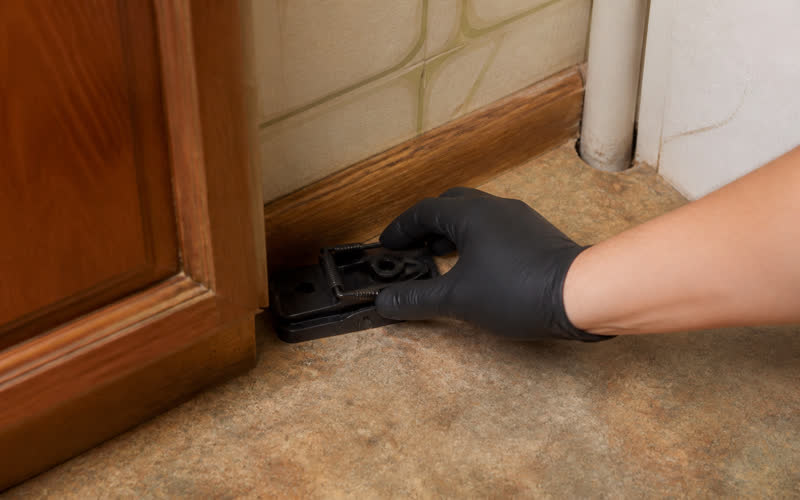
Mice travel along walls, not across the middle of a room. So the trap goes tight against the wall, with the mechanism turned towards the wall rather than out into the room. Space traps 2–3 metres apart, and in a room with activity you realistically need 3–4 traps, not one. A single trap in the kitchen is the commonest mistake: it catches one mouse and creates the impression that the problem is solved. For bait, peanut butter, chocolate spread or a small piece of dry sausage work better — cheese is a myth, it dries out quickly and does not interest a mouse. Use a pea-sized amount, smeared into the mechanism so it cannot be taken without touching it. For the first two nights some traps may sit untriggered — that is normal, mice go around new objects at first.
How to tell whether the problem is solved or only paused
A couple of quiet nights prove nothing — mice also go quiet when they move to another room or are feeding young. A check test is more reliable. Clean every place where there were droppings, mark them, and check each morning for seven days to see whether new ones appear. At the same time leave a thin dusting of flour at two of the entry points you found earlier. If in the course of a week there are no new droppings, no tracks and no gnawing on packaging, the situation is closed. Repeat the check a month later, especially in autumn.
If activity returns after two weeks
When two weeks are quiet and then droppings appear again, it almost always means the source is not in your flat. Mice come in from the stairwell, the basement or a neighbour's flat through shared shafts and pipe outlets. In older Riga buildings the ventilation ducts are connected the whole way up the stack, so fighting it in one flat gives only a short-lived result. Talk to the neighbours and the building manager. If you want a professional solution, fill in the form on our website: we work in Riga around the clock and reply within 5 minutes.
Frequently asked questions
How quickly can you get rid of mice in a flat?
Activity usually drops within a few days, provided the gaps are sealed at the same time.
Are mice in a flat dangerous?
They contaminate food and surfaces with droppings, so the hygiene risk is real.
Are shop-bought traps enough?
Only for a while. Without sealing the gaps, new mice will come.
Can mice come in through the ventilation?
Yes. Ventilation ducts in blocks of flats connect the flats the whole way up the stack, and mice move through them freely. Check that the kitchen and bathroom grilles are intact and screwed down tight. If there are droppings behind the grille or a grey, footprint-like film, that is your main entry point.
Why are the traps empty while droppings keep appearing?
Most often because the traps are in the wrong place — in the middle of the room rather than against the wall — or because easier food is still available in the flat. A mouse chooses the crumbs behind the cooker over an unfamiliar device. Clear the food sources first, then move the traps onto the track lines along the walls.
How long do mouse droppings stay in a flat after the problem is solved?
They do not go anywhere on their own — they stay until they are cleaned up. That is exactly why, after the last mouse is caught, it is worth washing out the cupboards, drawers and the floor behind the appliances thoroughly, once. It also removes the scent trails the next mice would navigate by.
Does treating a small flat cost less?
Yes, the price depends on the number of rooms. A one-room flat is €40, two rooms €55, three rooms €70, four rooms €80. These are final prices. If you are not sure which applies, fill in the form and describe the situation — we reply within 5 minutes.