
At a glance
- Page topic
- How to repel mice — what works and what does not
- Area covered
- Riga and the surrounding region
- Price
- From €40 — the figure quoted is the final price
- Availability
- 24/7, weekends and nights included
- What works
- Metal mesh with a 5 mm aperture and cement mortar; expanding foam does not
- How to book
- Enquiry form only — we reply within 5 minutes
This field is full of promises and short on evidence. Below — what actually changes the situation and what is a waste of money.
Ultrasonic devices
In practice the effect is limited and short-lived. Rodents get used to them within days or weeks, and the sound does not pass through walls and furniture. As the only measure — it does not work.
Peppermint oil and scents
Strong smells can keep rodents away from a particular spot for a short time, but they do not stop them if there is food in the room. The effect fades as the oil evaporates — after a few days. Useful as an addition, not as a solution.
Folk remedies
Bay leaves, garlic, ammonia — at best they change the route an animal takes, they do not remove the problem. A rodent with food and a nest will put up with the smell.
What really works
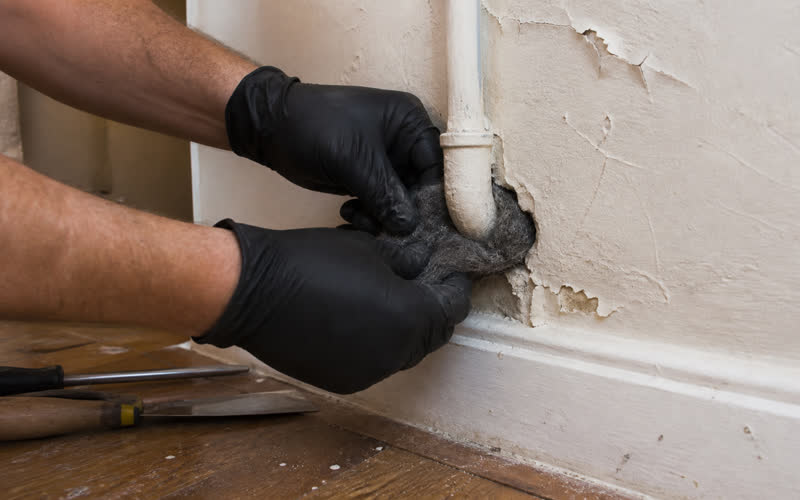
A physical barrier and removing the food. Sealing a 6–7 mm gap with metal mesh stops a mouse regardless of how badly it wants to get in. It is the only form of deterrence there is no habituation to.
Habituation — the principle that undoes every sensory repellent
Every repellent that acts on sight, hearing or smell shares one weakness: the animal gets used to it. Biologically that makes sense. A stimulus that repeats and never leads to any real consequence stops being information and becomes background — exactly as a person stops hearing the hum of the fridge after half an hour. For a mouse the process is fast, because it has the strongest possible motivation on the other side: a warm room in winter and food within reach. In practice that means a new repellent may show a visible effect in the first few days — which is precisely why people believe in them — but after a week or two the activity returns to its previous level. No smell, sound or light gets round this.
Light and noise: why they do not work indoors
The idea of pretending the room is occupied sounds sensible. In reality mice already live in homes where people walk about, talk and switch lights on every day, and it is for that very reason that they have learned to adapt to human presence. A light left on in the kitchen changes the timing of mouse activity, not the activity itself — the animals simply shift their movements to a later hour or pick shadier routes along the wall. A radio or television playing all night gives the same result, plus the electricity bill and your own disturbed sleep. The one situation where light gives a small practical benefit is temporary: a new stimulus may delay animals entering a room you have just cleared for a couple of nights, while you get the real work done.
Cats and dogs — an honest assessment
A cat in the house does affect the situation, but not in the way people hope. An active hunter may catch the odd animal and, by its scent, keep mice out of some rooms; that is a real but limited effect. The trouble starts with the fact that mice nest in places a cat will never reach — wall cavities, behind fitted furniture, under the floor, in the floor void. The population keeps growing there while one or two animals are caught in the kitchen. The other side of it is that a cat or dog bowl left out around the clock is one of the best food sources a mouse can find in a house. A pet often sustains the situation rather than solving it. Feed at set times and take the bowl away after the meal.
What humane deterrence can achieve and what it cannot
The wish to solve the problem without killing anything is understandable, and it is partly achievable — just not with scents. In practice a humane approach means one thing: making the space unusable. With no food, no water, no nesting material and no way in, the animals leave of their own accord, because the space no longer serves any purpose. This works well where the population is still small and there is no nest with young. It does not work once the animals are already breeding in the wall — a female with a litter will not leave, and any stimulus will only move her deeper into the structure. The honest boundary is this: for prevention and an early stage, the humane approach is entirely sufficient; for clearing an established population, it is not.
The one repellent with no habituation effect — room by room
Physical inaccessibility is the only method an animal cannot get used to, because there is no stimulus to get used to — there is simply no way through. Work through the home systematically. Kitchen: the gap behind the fitted cupboard carcass, holes around the water and waste pipes under the sink, the ventilation grille. Bathroom: the pipe outlet, the access hatch. Hallway: the gap under the front door and the threshold. Basement and plant rooms: window frames, cable entries, the heating main entry. Fill every opening wider than six millimetres with steel wool or fine mesh, and only put the finishing material over the top. One room an evening is a realistic pace; the whole home is covered within a week.
Where to spend the same money for a better result
A set of ultrasonic devices for three rooms costs more than all the materials needed to seal an entire house. The same sum is far better spent on: stainless steel wool and fine metal mesh, silicone or an exterior-grade filler, new draught sealing for the bottom of the door, metal grilles for the ventilation outlets, six to ten good mechanical traps and airtight containers for dry food. That kit addresses the cause rather than the symptom, and it lasts for years rather than until the battery dies. If activity continues after sealing and two weeks of trapping, the cause is most likely outside your own space. In that case fill in the form and describe what has already been done — we reply within 5 minutes.
Frequently asked questions
Does ultrasound work?
Only to a limited extent and briefly — rodents get used to it.
Does peppermint help?
Briefly, and only as an addition.
What is the most effective measure?
Sealing entry points and removing food.
Why did the repellent seem to work in the first week?
Anything new in a mouse's territory changes its behaviour for a few days — that is natural caution towards the unknown. Once it becomes clear the stimulus is not dangerous, the animal habituates and returns to its usual routes. It is that first-few-days illusion that keeps people believing in devices which change nothing in the long run.
Can scents be used alongside traps?
Better not. A strong smell in the room stops a mouse picking up the scent of the bait and can divert it away from the trap line, drawing the process out. If you do use fragrances, keep them several metres from the traps and never apply them to a trap or close to one.
Is there any point in repellents in an outdoor shed or garage?
Slightly more than in a living room, since mice visit those spaces rather than living in them permanently, but the principle is unchanged — habituation happens there too. It is far more effective to seal the bottom of the doors, fit metal mesh over the ventilation openings and stop storing food or seed in paper sacks.