
At a glance
- Page topic
- Rodent monitoring
- Area covered
- Riga and the surrounding region
- Price
- From €40 — the figure quoted is the final price
- Availability
- 24/7, weekends and nights included
- What works
- Metal mesh with a 5 mm aperture and cement mortar; expanding foam does not
- How to book
- Enquiry form only — we reply within 5 minutes
On commercial sites monitoring replaces reaction with prevention: activity is spotted at a control point rather than when a member of staff or a customer sees a rodent.
How the control points work
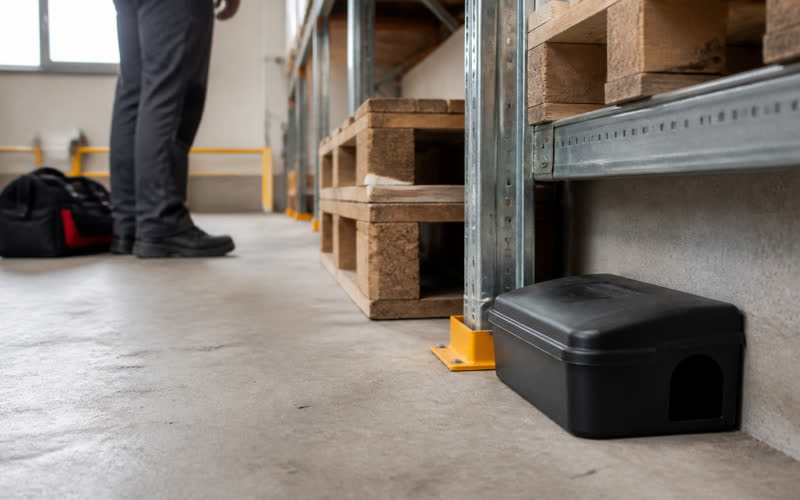
Every station has a number and a place on the site plan. At each check it is recorded whether there is activity at that particular point. Comparing checks shows which side the pressure is coming from.
What a regular check covers
Inspection of every point, recording of activity, replacement of used product, adjustment of the layout, and a written record of the work carried out.
Why documentation matters
Food businesses, warehouses and production sites need to be able to show that control is happening regularly. The written record of the work carried out and the control point layout demonstrate that.
Frequency of checks
It depends on the type of site and the activity found. Less often on low-risk sites, more often in the food chain and in warehouses.
Monitoring blocks with no active substance
Not every control point needs a product in it. Monitoring blocks imitate bait without any active substance — a rodent gnaws them just the same, but nothing happens. That makes it possible to establish activity without chemicals, and it is exactly why they are used in food handling zones, in rooms with children and on sites where an active product is not acceptable. If gnawing appears in a block, that is the signal to step up control in that particular zone. In practice many sites use a mixed system: active points around the perimeter and at the entry points, monitoring blocks in the interior zones. That way the active substance stays where the rodents come in, not where people work or food is handled.
How the trend in the data changes decisions
The result of a single check tells you little. The value comes from comparing several checks in a row: if take is rising at the points by the loading bay while the rest of the site is at zero, the problem is coming in with the goods. If activity rises at every perimeter point at once, the pressure is from outside — often after building work or a change on a neighbouring site. It is precisely that difference that decides whether to fix a door threshold or review the goods-in procedure.
What a rise at a single point means
A rise at one control point almost always indicates an entry point close by. In that case we check that part of the building in more detail: pipe entries, cable runs, thresholds and ventilation openings within a five- to ten-metre radius. Often the answer is not more stations but one structural repair — replacing the seal on a door threshold, say, or putting mesh over a ventilation opening. If take falls at that point after the repair but rises at the point next to it, the rodents have found a way around, and the inspection has to continue in that same part of the building.
When the system needs reviewing
A site does not stay the same. Refurbishment, a new neighbouring business, a relocated bin store, a change of season or a change in the flow of goods — each of these alters the rodent pressure. After any significant change the control point layout should be reviewed rather than carried on to the old plan. Often moving a few points is enough.
What staff do between checks
Between visits, the most important thing is to report what has been seen: gnawing on packaging, droppings, a damaged or moved station. Staff should not move, open or top up stations — that both creates a risk and corrupts the data the whole system rests on. A clear reporting procedure usually achieves more than more frequent checks. The most practical arrangement is one responsible person on site who notes observations with the date and the location. Those notes, together with the data from our checks, show whether activity is rising between visits and whether the frequency is right.
When the frequency of checks can be reduced
If several checks in a row show zero activity at every point and the structural repairs have been made, the frequency can be reduced. This is a normal, planned step, not a stopping of the service: less frequent checks still keep the system running and will register any return of pressure. On sites with a constant flow of goods, stopping altogether usually means being back at square one within a few months.
Frequently asked questions
How often do the checks happen?
It depends on the site and the level of activity.
Will I receive documentation?
Yes — a written record of the work carried out and the layout of the points.
Is monitoring needed for a flat?
Usually not — it is a solution for commercial premises.
Is monitoring worthwhile on a site that has no rodents at present?
Yes, and that is exactly where it is most valuable. The system registers activity before it becomes visible in the rooms, and lets you act while the problem is still small.
What does the client receive after each check?
A written record of the work carried out, giving the activity found at each point, the actions taken and recommendations. Together with the control point layout it builds up a history of the site.
Does monitoring replace treatment?
No. Monitoring shows where and when to act. If activity is found at a point, treatment is carried out there and observation then continues.