
At a glance
- Location
- Āgenskalns
- Service
- Rodent control — rat and mouse extermination
- Price
- From €40 — the figure quoted is the final price
- Availability
- 24/7, weekends and nights included
- Getting there
- We travel from Riga; arrival time agreed per address
- How to book
- Enquiry form only — we reply within 5 minutes
Rodent control in Āgenskalns: timber building stock changes the task
Āgenskalns is the historic centre of Pārdaugava, where timber and masonry buildings stand next to one another on the same street. It is the timber stock that determines how rodent control takes shape here. A historic wooden house is not a sealed structure: the board cladding works loose over time, the bottom log rots away, and a continuous band of gaps is left between the foundations and the wall. A house mouse squeezes through a 6–7 mm opening and a brown rat needs only 20 mm — in a timber house there are dozens of such places, not one or two. That is why rodent control in Āgenskalns starts with a full inspection of the building perimeter, not with putting bait down where the noise was heard. In masonry buildings the task is different — there are fewer ways in, but they are deeper and tied to the services, so two houses on the same street can call for completely different plans.
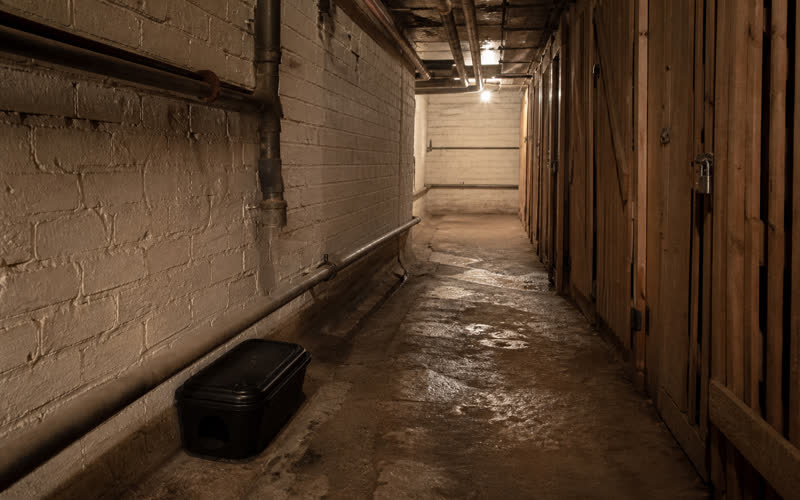
The crawl space: the main home in a timber house
In old timber houses there is a crawl space between the ground and the floor — a low, ventilated void that people rarely enter, and that is exactly what makes it an ideal place to live. It is dry, warm and undisturbed, and from there a rodent can reach any floor by way of the pipe entries. We always check the crawl space during the inspection: we look for trodden runs, nesting material, droppings and grease marks 5–10 cm above the base along the joists. Outside, at the edge of the foundations, we look for the entrance to a rat burrow — a hole in the ground 5–8 cm across, often under a terrace or screened by shrubs. Control points go both in the crawl space and around the foundations, because treating the interior alone gives no result in a timber house. In the crawl space it is also important to assess damp and any stored belongings — these often serve as nesting material.
The market and food trade as a permanent food source
Āgenskalns market and the food trade around it create a permanent food source that affects a far wider area than the market square itself. Food waste, packaging and the container area act as a stable resource all year round, and the brown rat establishes permanent routes from such a point to the surrounding buildings. In practice that means residential buildings in the blocks nearest the market are under constant pressure from outside, and a one-off treatment there does not hold. At addresses like these we build an outer line of defence: bait stations between the food-source side and the building, so the rodent is intercepted before the foundations, and regular checks rather than a single callout. In autumn, as the temperature falls, movement towards buildings becomes more pronounced, and that is exactly when we tighten the schedule of checks so that activity is spotted earlier.
Catering and shops around the market: control points and records
Rodent control in a restaurant or a shop in Āgenskalns near the market calls for a permanent system. We set up numbered control points around the perimeter of the premises and separate monitoring positions indoors — at the goods intake door, in the store room and behind the refrigeration units. At each visit we record which points show activity, what has been changed and what structural shortcomings have been observed; a written record of the work carried out stays at the site so that the trend can be seen. We pay particular attention to the goods intake route: during unloading the doors stand open, and behind the building is the waste area — that is the most typical way in. The rubber seal under the doors and the state of the threshold have to be checked at every visit in premises like these, because they wear quickly and open up a free gap again. For commercial sites prices start from €70, depending on the area and the number of control points.
Why expanding foam does not work in a timber house
In a timber structure a gap is rarely single and rarely straight — it runs along the edge of a joist, around a pipe entry and under the cladding. Expanding foam gives you nothing here: a rodent gnaws through it in a few nights, and in timber it also traps moisture. What works is metal mesh of 5 mm aperture combined with cement mortar or, in timber elements, a metal sheet cover. We seal entry points in Āgenskalns in stages, starting with the crawl space vents, the foundation line, the pipe entries and the gaps under doors. Without this step, mouse extermination in a timber house is only a reduction in numbers for one season. We record every place that has been closed, so that at the next visit it is clear what has already been done. Treating a private house costs €90–110, treating a flat €40–80, and the minimum callout charge is €40.
Divided old houses: when there is more than one owner
Many of the historic houses in Āgenskalns have been divided into separate flats with different owners, while the crawl space, the roof space, the ventilation shaft and the sewer stack stay shared. That is why rodent control in a flat here often runs into an organisational problem: one owner orders treatment, the neighbour refuses, and the rodents simply move through the shared structure. We always recommend involving the building manager, or agreeing between owners on an inspection of the whole building — with the cost split it usually works out cheaper than repeated callouts to one flat at a time. In such cases we set out the results of the inspection so that they can be shown to the other owners as well. We work 24/7, including emergency callouts. Fill in the form, stating the type of building, the number of storeys and whether the crawl space can be accessed; we reply within 5 minutes and tell you what is worth inspecting first in your particular case.
What rodent control in Āgenskalns includes
Rodent control in Āgenskalns means a full cycle, not a single treatment. Rat extermination and mouse extermination start with an inspection: we identify the species, find the movement routes and the entry points, and only then choose the method. Rodent control involves placing tamper-resistant bait stations or mechanical traps on the runs that are actually used, rechecking them, and giving specific advice on what needs sealing so the problem does not come back. The price depends on the type and size of the property: treatment starts at €40, and the figure quoted is the final price. Describe the property in the form — we reply within 5 minutes.
Frequently asked questions
Does the whole timber house need treating if the rodents are only in one flat?
In practice, almost always yes. In a timber house the crawl space, the wall voids and the shafts connect all the flats, so treating one flat only moves the problem next door. We inspect the whole building and place control points in the crawl space and around the foundations — where the rodents actually live, not just where the noise can be heard.
How do you get into the crawl space if the hatch has been bricked up?
If there is no access, we work from outside — through the foundation vents and around the perimeter, where we look for burrow entrances 5–8 cm across. That is less precise, so if it is possible we recommend restoring at least one inspection hatch; it makes both the inspection and the building manager's work easier in future.
We live by the market. Will treatment help at all?
It will, but it has to be planned as ongoing protection rather than a single callout. Beside a permanent food source the pressure from outside does not go away, so we form a line of bait stations between the market side and your building and close the entry points. Regular checking matters more there than a one-off treatment, because the area around the market offers food all year round.
Would foam around the pipes do if it is painted over?
No. Neither paint nor the density of the foam stops a rodent — a house mouse squeezes through a 6–7 mm opening and foam is gnawed through in a few nights. The only thing that works is metal mesh of 5 mm aperture together with cement mortar or a metal cover. In timber elements we fit it so that the structure is not damaged and inspection remains possible later.