
At a glance
- Location
- Zolitūde
- Service
- Rodent control — rat and mouse extermination
- Price
- From €40 — the figure quoted is the final price
- Availability
- 24/7, weekends and nights included
- Getting there
- We travel from Riga; arrival time agreed per address
- How to book
- Enquiry form only — we reply within 5 minutes
Rodent control in Zolitūde: a district on the edge of the city
Zolitūde lies in the western part of Pārdaugava, and from a rodent-control point of view its defining feature is its position on the city boundary. On one side there is dense apartment housing with all the usual problems of a Soviet-era apartment block; on the other, the direction of Mārupe, the airport zone and undeveloped open land. In inner-city districts no such boundary exists; there the rodents already live in the buildings and move between them. In Zolitūde something else happens every year: in autumn new animals come in from the open ground outside. That means working on the basement alone is not a complete solution — the side of the building that faces outwards also needs proper perimeter protection. An inspection here starts outside and only then goes in.
The field mouse in autumn: why September and October are a different season
The field mouse is not a city animal. It spends the summer in open ground — meadows, grassland, ditch edges, untended land — living on seeds and plant material. When the nights turn cold and the fields are cut or ploughed, it looks for warm shelter, and the nearest warm structure is a building. In Zolitūde that means a sudden wave of arrivals in September and October, which residents often mistake for a permanent problem in the building. The difference matters: a settled colony in the basement needs a different answer from a seasonal influx from outside. In the second case what decides the outcome is sealing entry points before the season. Mouse extermination after the fact is more expensive and has to be repeated every autumn if the entry points stay open.
The perimeter on the outward-facing side
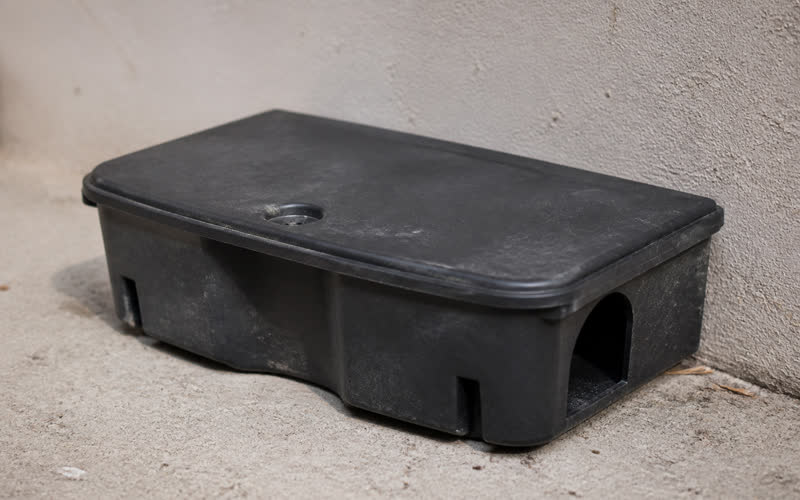
In practice the work looks like this. We walk the side of the building that faces the undeveloped land and check the whole plinth line: joints, cracks, ventilation grilles, basement windows, pipe entries and the gaps under basement door thresholds. Both house mice and field mice get through a 6–7 mm gap, and a brown rat needs only 20 mm — so the list of places to seal is longer than it looks at first glance. Protective mesh aperture: 5 mm. Expanding foam is no use for this job: a rodent chews through it in a few nights. What works is metal mesh bedded in cement mortar. In addition we place bait stations in an outer ring, so the animal is intercepted before the building rather than after it is already in the basement. This is the layer that is usually not needed in the inner city.
Basement and heating substation: where the arrivals settle
Once an animal is inside it looks for warmth, and the heating substation is the most suitable place in the whole building. The temperature is stable, it is damp and there are few people about. From the basement the route continues upwards along the ventilation shaft and beside the sewer stack. So we put the internal control points at the heating substation, at the bases of the risers and along walls where grease marks are visible 5–10 cm above the floor. The brown rat avoids new objects for 3–7 days, so a first check with no bait take means nothing yet. Autumn arrivals are usually mice, and they do not behave that way — their activity at a bait station shows up sooner. Droppings help tell them apart: 3–6 mm for mice, 15–20 mm long for brown rats.
Rodent control in a flat, and what a resident can do themselves
In a flat in Zolitūde the weak points are the same as in any Soviet-era apartment block, but in autumn they are used more often. Check the ventilation grille in the kitchen and bathroom, the pipe entry under the sink, the space behind the bath, the corners behind skirting boards and the gap under the balcony door threshold — the last of these applies particularly to first and second floors on the outward-facing side of the block. Keeping dry food in sealed containers is a simple step that removes the main reason to stay. Rodent control in a flat: one-room €40, two-room €55, three-room €70, four-room €80. Treating a private house €90–110, minimum callout €40. Send your enquiry through the form — we reply within 5 minutes and we work 24/7.
Commercial premises towards the airport
Along the outer edge of the district and on the way towards Mārupe there are warehouses, offices and retail units, and they come with their own set of problems. Seals under roller doors, loading dock thresholds and the goods-in area are the most typical routes in — and some rodents do not enter the site at ground level at all, but arrive with pallets and cardboard packaging. Here we work with a numbered system of control points: a fixed layout around the perimeter and the internal risk areas, a record of bait take and of any gaps found at each inspection, with the documentation staying on site. On sites bordering open ground the outer ring is compulsory, not optional. Work on commercial premises from €70, with the scope depending on floor area and the number of control points.
What rodent control in Zolitūde covers
Rodent control in Zolitūde means a full cycle, not a single treatment. Rat extermination and mouse extermination start with an inspection: we identify the species, find the runs and the entry points, and only then choose the method. Rodent control includes placing tamper-resistant bait stations or mechanical traps on the routes actually in use, a follow-up check, and specific recommendations on what to seal so the problem does not come back. The price depends on the type and size of the property: treatment starts from €40, and the figure quoted is the final price. Describe the property in the form — we reply within 5 minutes.
Frequently asked questions
Why do rodents turn up in autumn in particular?
Zolitūde borders open, undeveloped land and the direction of Mārupe. The field mouse lives outside buildings in summer, but as the cold sets in and the grassland is cut it looks for warm shelter. The nearest warm structure is a residential building, so in September and October the influx increases.
What is the practical difference between a field mouse and a house mouse?
Mainly where it has been. The field mouse comes in from outside seasonally, so what works against it is sealing the perimeter before autumn. The house mouse already lives in the building permanently, and there the basement and the vertical routes matter more. Droppings are 3–6 mm long for both, as against 15–20 mm for a rat.
Does perimeter protection mean bait stations all the way round the building?
Not only that. Perimeter work starts with sealing entry points: joints in the plinth, basement windows, ventilation grilles, pipe entries. Mesh aperture 5 mm, because a mouse gets through 6–7 mm. Bait stations in an outer ring are the second layer — they intercept the animal before the building, but they do not replace sealing.
Is expanding foam any use for filling holes in the plinth?
No. A rodent chews through foam in a few nights, and the hole reopens exactly where it was. The only solution that holds is metal mesh with a 5 mm aperture, bedded in cement mortar. The same applies to pipe entries in the basement and inside the flat under the sink.