
At a glance
- Location
- Iļģuciems
- Service
- Rodent control — rat and mouse extermination
- Price
- From €40 — the figure quoted is the final price
- Availability
- 24/7, weekends and nights included
- Getting there
- We travel from Riga; arrival time agreed per address
- How to book
- Enquiry form only — we reply within 5 minutes
Rodent control in Iļģuciems: an industrial inheritance in a residential district
Iļģuciems is a large residential neighbourhood in Pārdaugava with an industrial past. Between the blocks of flats and the streets of private houses stand the buildings of former works — some converted, some only partly used, some empty for years. For rodents that is an ideal set of conditions: warm, dry space that people rarely visit, a few dozen metres from a residential block. The brown rat nests there permanently and feeds outside — at the bin areas and against the plinth of the building. Rodent control in Iļģuciems is therefore rarely a single address. During the inspection we always establish what structure sits inside the block or behind the building, because that is usually what explains why the problem returns after every treatment.
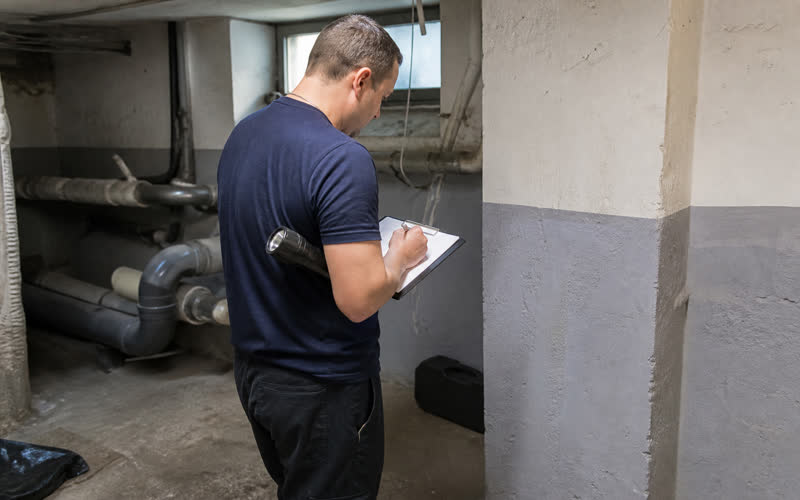
Old underground services connect buildings that look unrelated from the street
Industrial development leaves more than buildings above ground. Under the blocks of Iļģuciems there remain old heating mains, ducts for process pipework and service tunnels linking sites that from the street are separated only by a lawn. A rodent travels dozens of metres through a duct like that without coming to the surface. In practice it looks like this: rats appear in the basement of a residential building even though the bin area is clean and the plinth is sealed — because the way in is the heating main entry in the wall. During the inspection we therefore follow every pipe that enters the basement from outside and look for grease marks 5–10 cm above the floor along its bed. Rodent control here also means sealing entry points around the main entry — metal mesh of 5 mm aperture in cement mortar, not expanding foam.
Apartment blocks: crawl space, heating substation, sewer stack
In the Soviet-era apartment blocks of Iļģuciems the basement runs the full length of the building, and there are service openings in the partition walls. Nesting concentrates around the heating substation, while entry into the flats happens by way of the sewer stack and water main entries in the floor slabs, and through the ventilation shaft. If one section is treated, the colony moves a few dozen metres and after a couple of weeks the noises appear in the next stairwell. Rodent control in an apartment building therefore rests on a chain of control points along the whole length of the basement: at the heating substation, at the bases of the stacks, at the external ventilation openings. The brown rat avoids new objects for 3–7 days — neophobia — so an empty bait station at the first check still means nothing. We coordinate the work with the building manager, as the basement is shared property.
Former production sites and part-used premises
At a site where two of five spaces are in use, the control point scheme must not stop at the part being used. The empty rooms, the lower floors and the service routes are exactly where nests form, and from there the rodents head into the active part every night. We work with numbered control points along the internal perimeter, at goods intake and the waste area, and at every place where a pipe or cable crosses the external wall. At every inspection we record consumption point by point and any new gaps — that shows the direction of movement. In converted production buildings it is particularly important to check the old process openings in the floor, which were covered over during the conversion but not sealed. Rodent control at commercial sites from €70.
Private houses and low-rise stock between the blocks
The private-house streets of Iļģuciems often lie close to former works and unmanaged plots. In autumn the pressure rises: the field mouse looks for warmth and comes in through the foundation vents, the house mouse squeezes through a 6–7 mm gap, and a rat needs about 20 mm. Around the building we look for burrow entrances 5–8 cm across, trodden runs along the fence and droppings — 3–6 mm points to a mouse, 15–20 mm to a brown rat. The answer has two layers: perimeter protection with bait stations along the property boundary, and sealing entry points at the foundations and pipe entries. Treating a private house is €90–110 depending on the area and the length of the perimeter; if there is an empty industrial structure next door, we plan a repeat inspection.
How to book the work and what you can do in the flat right now
We work 24/7, including emergency callouts. Fill in the form, state the type of property and mention whether there is or has been a production building nearby — we reply within 5 minutes. In the meantime there is plenty you can do in the flat: check the pipe entry under the sink, the gaps behind the bath, the ventilation shaft grilles and the corners at the skirting boards. Mouse extermination and rat extermination start with closing the entry points, and expanding foam does not work here — you need metal mesh of 5 mm aperture in cement mortar. Leave droppings untouched until the inspection: we identify the species from their size. Rodent control in a flat: one room €40, two rooms €55, three rooms €70, four rooms €80. Minimum callout €40.
Frequently asked questions
Why do rats appear in the basement when everything around the house is in order?
In Iļģuciems there are old heating mains and process pipe ducts from the industrial period beneath the blocks. Rodents travel dozens of metres along them without coming to the surface and enter the basement through the main entry in the wall. That is why during the inspection we always follow every pipe coming in from outside.
Does an empty production building next door really affect my house?
Yes. Space that is unoccupied, warm and rarely visited is long-term shelter in which a colony nests permanently while feeding outside — at the bins and against the plinths of buildings. While that source is untreated, repeated rodent control in Iļģuciems in the residential building gives only a temporary result.
How long does it take to see a result after bait stations are placed?
The brown rat avoids new objects in its territory for 3–7 days — that is neophobia. An empty station at the first check is therefore not a failure. We assess consumption at the repeat inspection and adjust the layout of control points in the basement and at the service entries accordingly.
What if the problem affects the whole building, not just my flat?
The basement, the heating substation and the ventilation shafts are shared property, so you need to go to the building manager and arrange treatment for the whole building. In the flat you can close the entry points in parallel — the pipe entries and the gaps around the sewer stack. Submit a request for both jobs through the form.